
Download PDF
Read media summary
Summary
The coalition Government has made virtually no progress on a number of food policy areas recommended by experts in a 2023 report, despite a health system overburdened with nutrition-related chronic disease and in crisis.
The fifth New Zealand Healthy Food Environment Policy Index (Food-EPI) reports on progress made on ‘food environments’ in the past three years. The food environment is the part of the food system that consumers directly experience, and encompasses the availability, visibility, cost and composition of foods.
The expert group has outlined policy priorities for immediate action:
- restricting children’s exposure to food marketing
- a sugary drinks levy
- food composition targets
- healthy and environmentally sustainable school-food policies
- commitment to and expansion of the healthy school lunch programme.
Most of these actions were proposed in 2020 and 2023.
Any action must be underpinned by agovernment-led national food systems action plan and a nutrition survey.
This Briefing outlines any progress in food policy by Government since 2023,1identifies implementation gaps, and proposes policy and ‘infrastructure support’ actions, which include activities like leadership, monitoring and funding.
Healthy diets are essential for wellbeing. About 15% of healthy life-years lost annually are from obesity and unhealthy diets.2 Diet-related non-communicable diseases (NCDs) are the biggest preventable cause of death and ill-health in Aotearoa New Zealand (NZ). These are related to the food environments in which New Zealanders live. Unhealthy food environments lead to unhealthy diets and excess energy intake, which contribute to morbidity and mortality.
Government has a critical role to play in creating healthier food environments. Food policies are a powerful tool to increase wellbeing (including mental health) and health equity, including honouring the rights of Māori to the protection of health under Te Tiriti o Waitangi.
What we did
The fifth New Zealand Healthy Food Environment Policy Index (Food-EPI) is an initiative of INFORMAS (the International Network for Food environments Research, Monitoring and Action Support), which aims to benchmark food environments and policies globally to increase the accountability of governments and the food industry for their actions to reduce NCDs and obesity.
Food-EPI assesses the progress governments have made towards best practice in improving food environmentsDs
The study consisted of a large panel of public health experts and has been conducted before the last four general elections.
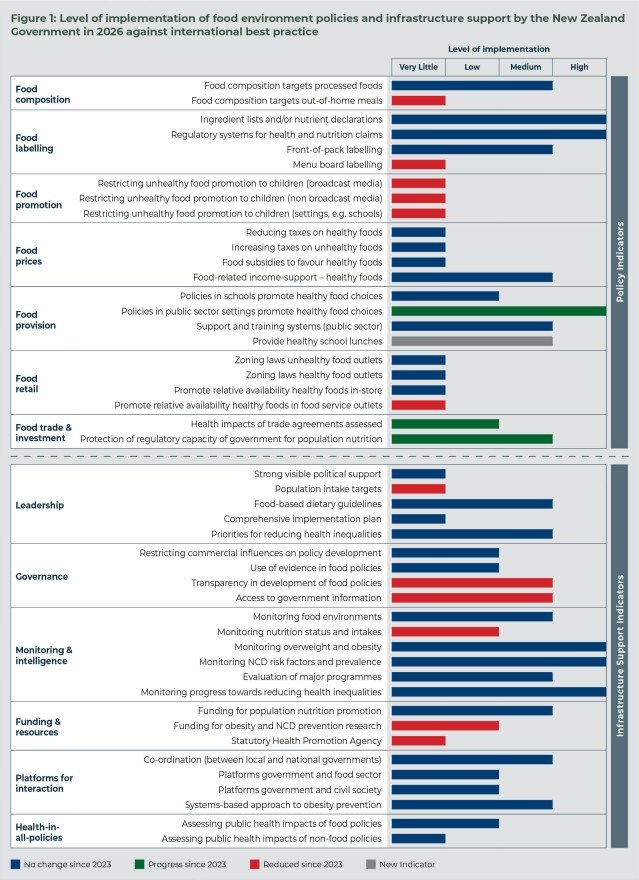
Food-EPI 2026 was conducted by compiling evidence of current implementation in NZ for policies on food environments and infrastructure support through publicly available information and validating this with government officials. The research team then benchmarked policies and actions of the Government against international best practice for creating healthier food environments (Figure 1of the report, see Appendix).
Three workshops were held in May and June 2026 to identify recommended actions for the NZ Government, with around 40 participants (the expert panel).After these workshops, around 30 experts ranked actions for immediate priorityity
Virtually no policy progress
Virtually no progress has been made in most areas since the 2023 Food-EPI assessment (see full evidence document).
About two-thirds of the policy indicators and half of the ‘infrastructure’ indicators (leadership, funding, restrict commercial influences on policy development, etc.) were rated as having ‘low’ or ‘very little, if any’ implementation.
The NZ Government continues to perform well in:
- preventing unhealthy foods from carrying health claims
- providing nutrition information panels on packaged foods
- transparency in policy development processes
- providing access to information for the public, and
- monitoring prevalence of NCDs and their risk factors and inequalities.
- the introduction of a mandatory healthy food policy in health-sector settings,3 such as hospitals, for staff and visitors
- consultation on mandatory Health Star Ratings underway4 (final approval required by Food Ministers in 2027), and
- a new Sustainable Food Systems chapter in a recent EU trade agreement.
Recommended actions
The expert panel has prioritised seven specific actions for immediate implementation to improve the healthiness of NZ’s food environments – five policy actions and two infrastructure support actions (Table 1).
The expert panel is very clear that, for any progress to be made, these actions need to be underpinned by clear leadership, adequate household incomes and environmentally sustainable dietary guidelines.
The Rebalancing our Food System report5(Public Health Advisory Committee 2024) should inform a government-led national food systems action plan.
Yet again, the expert panel calls for funding for a national nutrition survey. The previous Child and Adult Nutrition Surveys were conducted 24 and 18 years ago, respectively.
The panel urges the Ministry of Education to make funding for the Healthy School Lunches programme (Ka Ora, Ka Ako) permanent, have a fair pricing model for suppliers, better meet children’s nutritional needs and expand the programme to reach more children, particularly given the increasing number of children living in material hardship. Sweden, Finland, South Korea,Brazil and many other countries provide universal free, healthy school lunches.6
The expert panel calls for a mandatory approach across all policy domains, particularly to reduce commercial influences on children. This includes restricting marketing of unhealthy food which children are exposed to and ensuring that only healthy foods and drinks are provided or sold in schools and early learning services. Also, requiring mandatory targets for reducing sodium and added sugar in key categories of packaged food. These are all ‘best buys’ recommended by the World Health Organization.7
The panel also recommends thatNZ adopt a sugary drinks levy, as is done in 116 countries8, withrevenue directed to specified health services or healthy food systems.
Food-EPI guided the top three policy calls to action in Health Coalition Aotearoa’s Prevention Brief 2026.9
Table 1: Seven specific actions for immediate implementation to improve the healthiness of NZ’s food environments as outlined in theNew Zealand Healthy Food Environment Policy Index(Food-EPI)
| Policy actions | |
| Mandatory Health Star Ratings | The Government makes the Health Star Rating system mandatory for all eligible packaged foods and regularly reviews the algorithm and logo design to maximise its effectiveness in promoting product reformulation and informed consumer choice. |
| Food composition targets | The Ministry of Health and the Ministry for Primary Industries create mandatory targets/standards for reducing sodium and added sugar in key food categories of packaged food. |
| Substantial levy on sugary drinks | The Government introduces a tiered industry levy of at least 20% on sugary drinks and recycles the revenue towards specified health services (eg, expanding free basic dental care) or healthy food systems (eg, expanding the Healthy School Lunch programme). |
| Regulations restricting children’s exposure to unhealthy food marketing | The Government introduces regulations to protect all children and young people up to 18 years by restricting unhealthy food and beverage marketing to which they are exposed across all channels, platforms and children’s settings, including online, outdoor, retail and sponsorship environments. |
| Healthy and environmentally sustainable food policy in schools | The Ministry of Education implements and monitors a mandatory healthy and environmentally sustainable food policy for schools and early learning services, ensuring that all food and beverages sold, provided, and procured meet defined standards, and allocates sufficient resources, support, and training for effective implementation. |
| Infrastructure support actions | |
| National Nutrition Survey | The Government conducts a new national nutrition survey for children and adults to be commissioned in 2027. |
| Healthy School Lunches (Ka Ora, Ka Ako) commitment and expansion | The Ministry of Education expands the Healthy School Lunches programme to double the reach over the next five years and commits to ongoing and appropriate funding through Vote Education, including continued support for food programmes in early learning services settings. |
What this Briefingadds
- Highlights the continued lack of progress by the NZ Government to implement best practices in food policy.
- Presents the five clear, achievable WHO-recommended policy actions, and two infrastructure support actions are recommended by an expert panel.
- Argues that implementing these would collectively result in positive outcomes for improved health, particularly for our children, increased equity and uphold Te Tiriti o Waitangi.
Implications for policy and practice
- The seven actions recommended must be prioritised by the next Government; Mandatory Health Star Ratings, food composition targets, substantial levy on sugary drinks, regulations restricting children’s exposure to unhealthy food marketing, healthy and environmentally sustainable food policy in schools, National nutrition survey, and a commitment to and expansion of the Healthy School Lunches (Ka Ora, Ka Ako) programme.
Authors details
Dr Sally Mackay, School of Population Health, Waipapa Taumata Rau | University of Auckland. Co-Chair, Food Policy Expert Group, Health Coalition Aotearoa.
Dr Kelly Garton, School of Population Health, Waipapa Taumata Rau | University of Auckland. Food Policy Expert Group, Health Coalition Aotearoa.
Dr Boyd Swinburn, School of Population Health, Waipapa Taumata Rau | University of Auckland. Co-Chair Health Coalition Aotearoa.
Dr Andrea Beros, Faculty of Medical and Health Sciences, Epidemiology & Biostatistics, Waipapa Taumata Rau | University of Auckland.
Appendix
Figure from New Zealand Healthy Food Environment Policy Index (Food-EPI) showing the level of implementation of food environment policies and infrastructure support by the NZ Government since 2023, measured against international best practice.