
(Aug. 13, 2026) – “We’ve officially used up all the vegetable samples,” my server announced.
We had just finished serving grilled vegetables to a long line of curious taste testers, many of whom were very young. On a sunny day at a farmers market, they eagerly sampled grilled summer squash, onions and canned pineapple slices.
I always enjoy the contagious excitement at farmers markets.
Besides samples, we provided several Field to Fork recipe cards and a handout showing how to grill almost any fruit or vegetable. Search for “Try Adding Some Fruits and Vegetables to Your Grilling Menu” on the North Dakota State University Extension website.
Attending farmers markets is a good plan on several levels. We can enjoy fruits and vegetables at their freshest and most nutritious. In many cases, the vegetables were picked shortly before their delivery to the market.
When we shop at farmers markets, we are supporting local farmers and their families as well as the local economy. You may have the opportunity to meet the person who grew the vegetables or fruits.
Unfortunately, lately, some produce grown or processed outside the U.S. has been implicated for contamination with a parasite, such as cyclospora in lettuce, or with a type of bacteria, such as salmonella in peppers.
Buying locally also reduces the distance food travels before reaching your table. Regardless of where produce is grown, proper handling remains important. Be sure to rinse fresh produce under cool running water. Keep cut produce cold, and avoid cross-contamination with meat juices.
The North Dakota Department of Agriculture offers a local foods directory map at https://ole.ndda.nd.gov/localfoods/, or you can search for “North Dakota Local Foods Map.” There, you can find farmers markets, on-farm sales, road stands, u-pick operations and other types of opportunities.
Besides finding fruits and vegetables, you can also explore where you can purchase eggs, meat, poultry, honey and other goods.
Depending on the state where you read this column, you might have similar opportunities to explore local foods using an interactive website. Check out your state’s department of agriculture.
Most children and adults shortchange themselves on fruits and vegetables, despite the abundant research showing that a diet rich in produce can lower the risk of heart disease, obesity and type 2 diabetes. Fruits and vegetables may protect against some types of cancer, reduce the risk of kidney stones and help reduce bone loss.
The 2025-2030 Dietary Guidelines for Americans encourages us to eat fruits and vegetables throughout the day. In general, adults need about three servings of vegetables and two servings of fruit per day. The amount we need varies with our age and physical activity, but a total of five servings is a good starting goal.
A serving of vegetables or fruit is one of the following: 1 cup of raw or cooked vegetables, 2 cups of raw leafy greens, 1 cup of raw fruit or ¼ cup of dried fruit.
I help in a community garden and was rewarded for my efforts with a couple of zucchini. We roasted them after removing the seeds, and we filled the cavity with leftover casserole. Here’s another way to enjoy bountiful zucchini. Check out “Let’s Enjoy Zucchini” at NDSU Extension for more ideas.
- 3 zucchini, sliced and seeds removed
- 1 tablespoon olive or canola oil
- ¼ cup uncooked quinoa (cook according to the package directions)
- ½ cup water
- ½ teaspoon garlic powder
- ½ teaspoon dried basil
- ¼ teaspoon oregano
- 1 cup grape tomatoes, sliced
- ¼ cup diced red onion
- ½ cup chickpeas, drained and rinsed, low sodium
- ¼ cup feta cheese
- 2 tablespoons green onions, chopped
- 2 tablespoons lemon juice (fresh or bottled)
- 2 tablespoons olive or canola oil
Preheat the oven to 375 F. Line a baking pan with parchment paper or use nonstick cooking spray. Rinse, dry and cut zucchini into halves. Scoop out the seeds of the zucchini with a spoon. Drizzle zucchini with 1 tablespoon of olive or canola oil. Bake 25 to 30 minutes until tender. Cook the quinoa while the zucchini is roasting. Scoop out the zucchini flesh. In a bowl, combine zucchini, quinoa, garlic powder, dried basil, oregano, grape tomatoes, red onion, chickpeas and feta. Mix oil and lemon juice in a separate container, then add to the quinoa mixture. Fill zucchini with mixture. Top with green onions.
Makes six servings. Each serving has 134 calories, 8 grams (g) fat, 5 g protein, 13 g carbohydrate, 3 g fiber and 130 milligrams sodium.
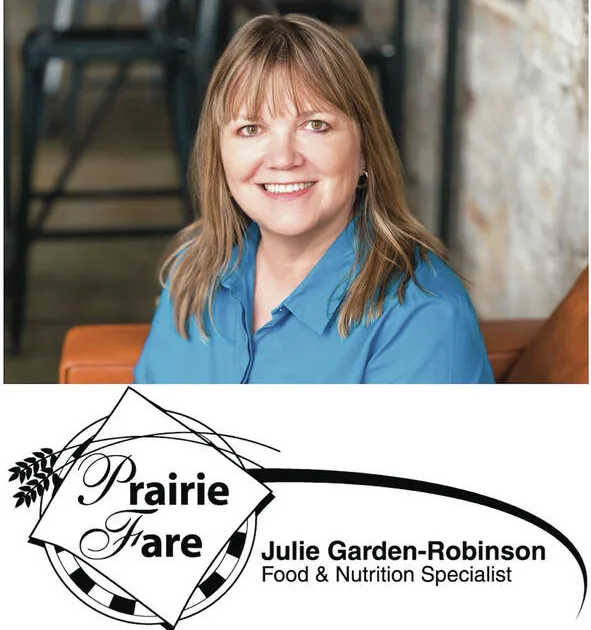
Julie Garden-Robinson, Ph.D., R.D., L.R.D., is a North Dakota State University Extension food and nutrition specialist and professor in the Department of Health, Nutrition and Exercise Sciences. This article is republished from NDSU Extension under a Creative Commons license. To view the original column, visit https://tinyurl.com/48rrwnab.
