

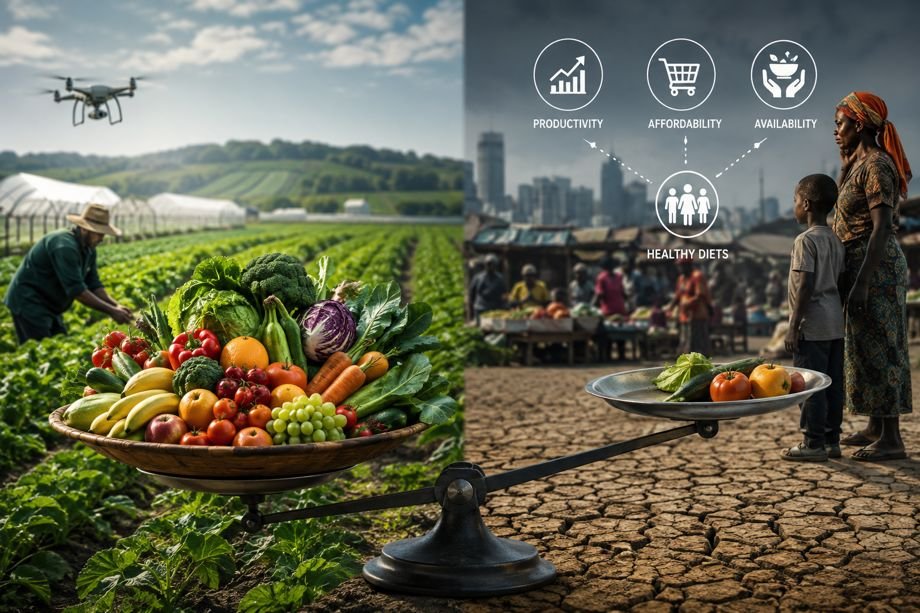
Global fruit and vegetable production has expanded rapidly, with horticulture now accounting for almost a quarter of agricultural production value worldwide. Yet that growth has not translated into adequate access to healthy diets, exposing persistent gaps in productivity, availability and affordability that FAO says must become central to the future of agricultural policy.
Global horticulture is expanding faster than many other parts of agriculture, but its success is exposing a deeper weakness in the food system: producing more fruits and vegetables does not automatically mean people can afford or consume enough of them. Between 2010 and 2024, fruit and vegetable production grew faster than cereals, while horticulture rose to nearly a quarter of global agricultural production value, worth about $1.4 trillion. Exports reached 175 million tonnes valued at $240 billion by 2024.
The economic momentum has not translated into healthier diets at the same pace. FAO Director-General QU Dongyu used the International Horticultural Congress 2026 in Kyoto to argue that agriculture can no longer be judged only by how much food it produces, but also by whether it delivers the diverse foods needed for healthy diets and whether those foods are available, accessible and affordable. The argument amounts to a broader rethink of what agricultural success should look like.
Horticulture Is Growing; Nutrition Is Not Keeping Up
The contradiction is striking because horticulture is already a major global industry. Fruits, vegetables and other horticultural crops generate enormous commercial value, support livelihoods and increasingly occupy a larger share of agricultural production. Yet the sector’s expansion has not closed the gap between what is produced and what people need to consume for healthier diets.
In 2023, only about half of countries produced enough fruits and vegetables to meet the joint FAO/WHO recommendation of 400 grams per person per day. Global average consumption was substantially lower, at an estimated 80 grams of fruit and 190 grams of vegetables per person daily. The gap shows why higher aggregate production cannot be treated as a substitute for actual dietary access.
Instead of asking only how agriculture can generate more output, governments must also consider whether nutritious foods are reaching consumers at prices they can afford. A food system may perform strongly in production and trade while still underperforming on nutrition if supply remains uneven, prices rise or distribution prevents adequate consumption.
The challenge is no longer simply increasing the volume of fruits and vegetables moving through farms and markets, but ensuring that expansion results in reliable, affordable access to the foods that healthy diets require.
Affordability Is Becoming as Important as Supply
FAO identifies productivity, availability and affordability as three interconnected barriers to unlocking horticulture’s nutrition potential. Productivity remains a concern because horticultural yields have increased by less than one per cent annually, lagging cereals amid underinvestment in research, genetics and infrastructure. Slow productivity growth places additional pressure on a sector expected to supply more nutritious food while facing tightening re
Affordability may prove even harder to resolve. Between 2016 and 2025, producer prices increased in 89 per cent of countries for fruits and 93 per cent for vegetables, with median annual rises of roughly 4.2 per cent and 4.7 per cent respectively. Rising prices matter because increasing production achieves little nutritionally if households cannot translate greater supply into greater consumption.
The imbalance is likely to become more significant in regions already facing supply constraints. By 2050, projections cited by FAO suggest that fewer than one-third of countries in sub-Saharan Africa will have enough fruits and vegetables available to meet the joint FAO/WHO recommendation. That outlook places nutrition, agricultural productivity and food affordability on the same policy agenda.
Horticultural policy cannot be separated neatly into production and consumption strategies. Investment in farms, infrastructure and markets will have to work alongside efforts to improve physical availability and economic access. Otherwise, commercial growth could continue without resolving the dietary gaps that make the sector strategically important in the first place.
Climate and Re
Expanding production will also become harder under tightening environmental constraints. FAO points to increasing pressure on land and water alongside rising temperatures, water scarcity, extreme weather, pests and diseases. In that context, future horticultural growth is expected to depend less on expanding cultivated area and more on producing efficiently with the re
The proposed response spans the entire production system: improved seed and planting material, healthier soils, efficient irrigation, mechanisation, digital technologies, extension services, better post-harvest systems and stronger connections between farmers and markets. This is significant because productivity losses do not occur only in fields; they also emerge through weak infrastructure, post-harvest losses and poor market access.
Technology is thus becoming a larger part of the horticulture debate. QU highlighted artificial intelligence, genome editing and digital tools as technologies accelerating breeding and reducing post-harvest losses, alongside mutation breeding supported through the Joint FAO/IAEA Centre. The broader direction is clear: innovation is being positioned as a way to raise output and resilience without proportionally increasing pressure on scarce land and water.
However, technological capability is not the same as widespread impact. Whether innovation changes food availability will depend on whether it can move beyond laboratories and large commercial operations into farming systems where affordability, infrastructure and technical support remain decisive constraints.
The Transition Will Succeed or Fail With Small Farmers
The implementation challenge is particularly important because smaller farms dominate global fruit and vegetable production. Farms of 20 hectares or less account for more than half of worldwide output, with their share rising above 80 per cent in Asia and sub-Saharan Africa. Any strategy that fails to reach these producers would therefore bypass much of the sector it is intended to transform.
FAO is consequently emphasising innovation that is accessible, affordable and practical for farmers to adopt. Governments are being urged to support research, seed systems, infrastructure, trade policy and markets that reward quality and nutrition, while giving farmers a central role in how new technologies and policies are introduced. The emphasis reflects a basic reality: technical solutions cannot deliver results if producers lack the means or confidence to use them.
The emerging model also rejects a simple choice between modern technology and traditional agriculture. Nearly half of the 104 systems recognised under FAO’s Globally Important Agricultural Heritage Systems involve horticulture, and FAO is arguing that traditional knowledge can be combined with newer technologies to strengthen productivity and resilience. Consumer behaviour and food waste are also part of the equation, broadening the challenge beyond the farm gate.
