


(Dan Tri Newspaper) – A mother said she regularly feeds her child packaged chicken porridge. However, despite the attractive images of chicken and vegetables on the packaging, the actual amount of chicken in the product is very small.

Food information overload
Dr. Trinh Hong Son, Director of the Center for Nutrition Education and Communication, Institute of Nutrition, shared this story at an information session in response to the “Nutrition and Development” Week, held on October 19th.
According to Mr. Son, he personally observed this story while conducting nutrition awareness campaigns in the community. From this, he raised concerns about the use of images on packaging that could create unrealistic expectations about the product’s actual composition, as well as the potential for violating legal regulations.
This could lead parents to mistakenly believe that feeding their children packaged “chicken porridge” provides sufficient nutrition, while the product’s nutritional content primarily comes from the rice. Consumers’ habit of reading food labels is also a concern.
According to Master’s student Son, the story illustrates the need for clear information on food labels, avoiding misleading descriptions that could cause consumers to misunderstand the ingredients and nutritional value. Both malnutrition and obesity in children are linked to dietary habits.
According to 2024 data from the National Institute of Nutrition, the national malnutrition rate among children under 5 years old was 14.8% for stunting, 8.3% for underweight, and 4.8% for wasting. The rate of overweight and obesity was 5.9%.
The rate of stunting among children varies between regions, being highest in the Northern Midlands and Mountains (20.3%) and the South Central Coast and Central Highlands (20.0%).

The National Institute of Nutrition recommends that people eat a balanced diet containing all four food groups: carbohydrates (rice, noodles, corn, potatoes, etc.); protein (meat, fish, eggs, milk, shrimp, crab, beans, etc.); fats (animal fat, vegetable oil); and vitamins and minerals (green vegetables, ripe fruits).
“Counting more than 10 types of food on the table shows that the meal is diverse. Fortunately, in Vietnamese culinary culture, dishes are often prepared by mixing many types of food, so basically, the meal is quite varied,” said Master Son.
According to this expert, no single food provides all the necessary nutrients for the body. A monotonous, unbalanced diet can lead to vitamin and mineral deficiencies.
“You should eat at least 15-20 different types of food every day. Many people find this number difficult, but it’s actually very simple. For example, a dish of stir-fried beef with bean sprouts, zucchini, scallions, garlic, pepper, fish sauce… already contains 5-6 different foods. Or in a bowl of pho, besides carbohydrates, there’s also meat, lime, onions, and various accompanying vegetables.”
“When cooking porridge for children, in addition to regular rice, you can add a little glutinous rice, sweet potato, or pumpkin to create sweetness and increase food variety. When eating fruit for dessert, instead of just one type, you can combine a little guava, lychee, or plum to diversify the food,” Dr. Son said.
Furthermore, each family should include a variety of colorful fruits and vegetables in their meals, as each type of vegetable contains specific nutrients and plant compounds. People also need to combine food groups appropriately, utilize local foodexaggerated advertising about the benefits of food
How to read nutrition warning labels?
According to Dr. Hoang Thi Duc Ngan, head of the Community Nutrition Department at the National Institute of Nutrition, adults aged 18-69 in Vietnam consume an average of 8.1g of salt per day, higher than the World Health Organization (WHO) recommended level of less than 5g/day.
The prevalence of hypertension among people aged 18-69 in Vietnam is 26%, which means that approximately 1 in 4 adults suffers from hypertension.
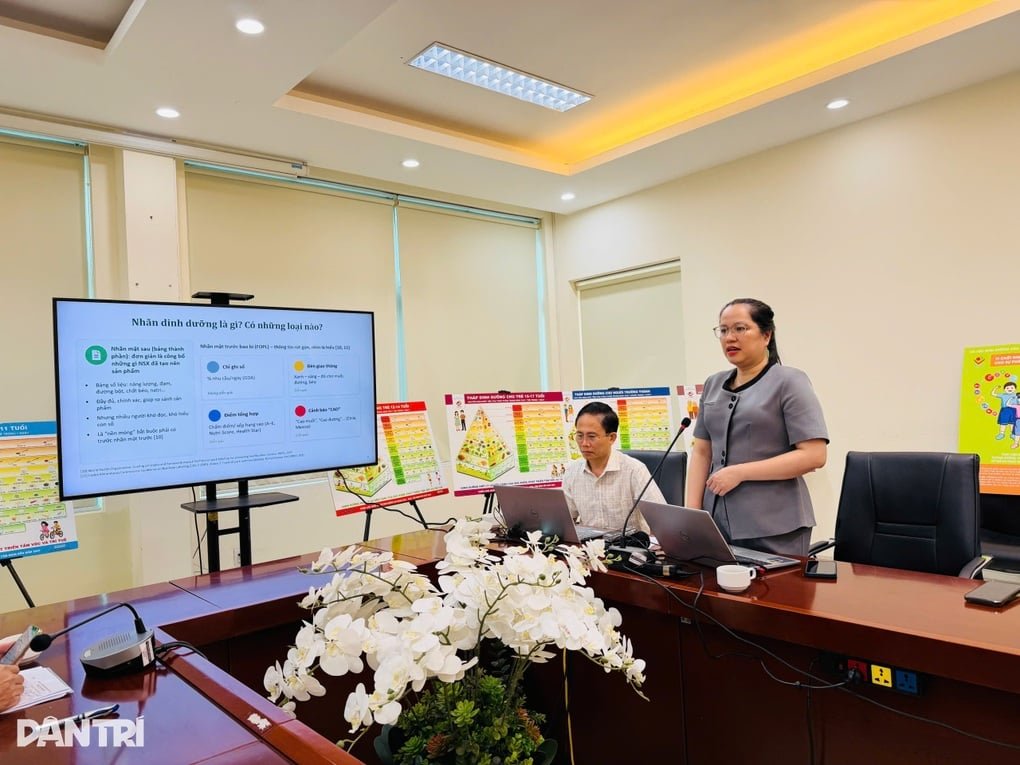
The rate of overweight and obesity among adults and those aged 5-18 is also approximately 20%.
“Unhealthy eating habits are a major cause of disease. Consuming pre-packaged products, ingesting large amounts of salt, sugar, and saturated fats… increases health risks.”
“Scientific evidence shows that a high-salt diet and an unhealthy eating pattern are risk factors associated with millions of deaths each year,” said Dr. Ngan.
According to this expert, Circular 30/2026/TT-BYT, effective from July 10, 2026, provides guidance on listing ingredients and nutritional values on food labels, creating a basis for providing clear and consistent information to consumers.
According to the circular, manufacturers must include information on energy, protein, carbohydrates, fat, and sodium on product labels.
However, she also pointed out that mandatory labeling does not mean consumers can fully read and understand the information.
A survey conducted in Hai Phong showed that only 28% of respondents had knowledge of reading nutrition labels related to salt content. The percentage of people who bought products with less salt after reading the label on the back of the packaging was 50%.
This indicates that many people are not yet in the habit of reading labels or do not fully understand the information on packaging, making it difficult to accurately determine how much energy, sugar, and salt a product provides.
“Therefore, consumers need to develop the habit of checking product labels when choosing food. Check how much energy the product provides, how much salt, sugar it contains, etc. Parents should also guide children to read product labels to develop good consumption habits,” said Dr. Ngan.
MSc. Son emphasized that the recommendation to consume less than 5g of salt per day includes not only the amount of salt used for cooking but also the salt present in natural foods, instant products, restaurant meals, and condiments such as salt used for dipping fruit.
“Just eating a bowl of pho in the morning can consume the equivalent of 85% of the recommended daily salt intake. Therefore, it’s necessary to pay attention to the salt intake in other meals to avoid exceeding the recommended limit,” said Master’s student Son.
According to Dr. Ngan, nutritional warning labels on the front of packaging can use simple symbols such as a black octagon, circle, or rectangle, accompanied by the words “HIGH SUGAR,” “HIGH SALT,” or “HIGH SATURATED FAT.” These symbols only appear when the product exceeds the limits set by the regulatory agency, based on the uniformly issued food classification model.
On October 19th, the Ministry of Health launched the 2026 “Nutrition and Development” Week, taking place from October 16th to 23rd, in response to World Food Day (October 16th), with the theme “Innovation Today – Good Nutrition Tomorrow”.
Dr. Nguyen Hong Truong, Deputy Director of the National Institute of Nutrition, stated that with the message “Innovating the food system towards sustainability, implementing a healthy diet for health today and tomorrow,” the week emphasizes innovation not only in technology and products but also in meal organization, information transparency, and practical guidance. Through this, everyone can easily choose and maintain a healthy diet daily.
Original article
https://dantri.com.vn/suc-khoe/bac-si-dinh-duong-bat-ngo-voi-mon-chao-ga-me-cho-tre-an-20261019182951546.htm
Tag:chicken porridgenutrition
Trending by Category

Why do we crave sweets more when we diet?
Báo Thanh niên2 giờ trước

Broccoli: Is steaming or boiling better for preserving its potential cancer-fighting properties?
Báo Thanh niên2 giờ trước

Signs of early-stage diabetes

Ebola outbreak: US raises travel advisory for Kenya.
Báo Tin Tức3 giờ trước

Drug response decoder
Báo Sài Gòn Giải phóng3 giờ trước

Understanding helps the women in the medical field become even more dedicated and committed.
Báo Dân trí3 giờ trước
