
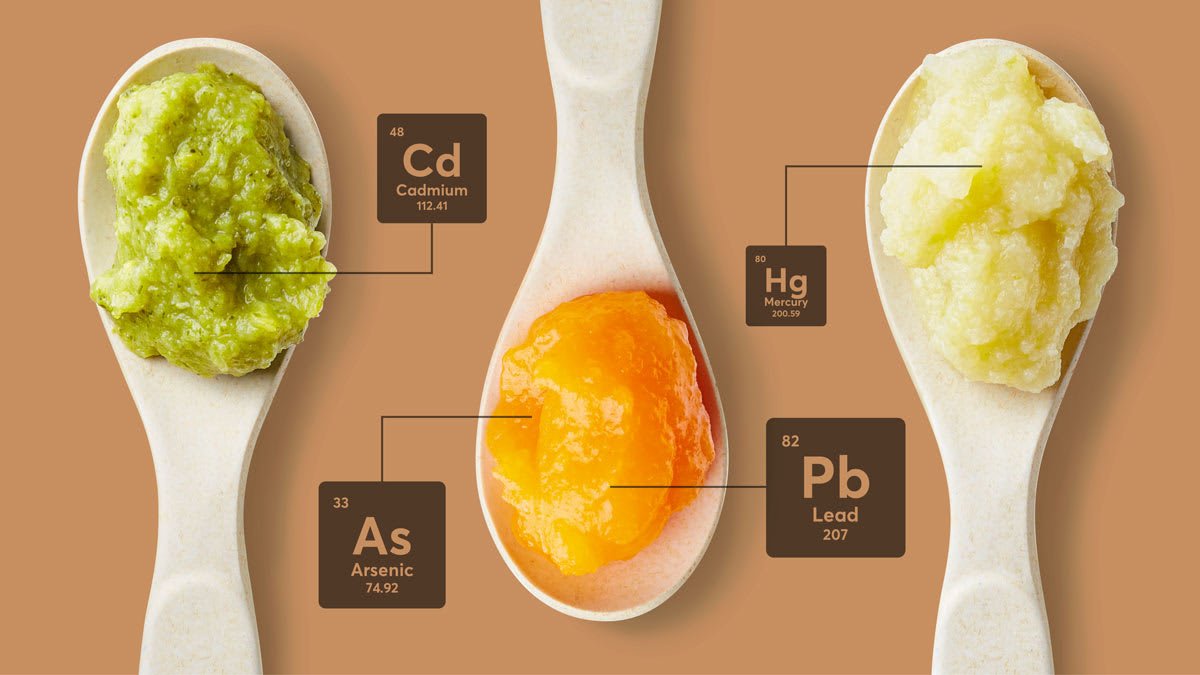
A new California law helps consumers figure out whether toxic elements are in their baby food.
Graphic: Consumer Reports
In March 2026, California Attorney General Rob Bonta issued an enforcement advisory letter to baby food manufacturers and retailers, reminding them of their responsibility to comply with Assembly Bill 899. “Parents should not have to question whether baby food is safe to eat, and that’s why California law requires companies to disclose the presence of heavy metals,” Bonta said in a public statement.
Since the initial publication of this report, several companies–including Little Spoon, Loco Bebé, and Piko Provisions–have taken steps to improve consumer access to their heavy metal-test results, such as removing the need for a lot code. We commend all efforts to increase publicly available information for families about the food their babies eat. The ratings in the chart below reflect our evaluations as of 2025.
Consumer Reports and Unleaded Kids,a nonprofit focused on protecting children from lead exposure, recently evaluated 39 baby food brands to see how easy they make it for parents to check their baby’s food for contaminants. A new California state lawrequires testing for toxic elements, including lead and arsenic, in most baby food, and the public disclosure of those results. We looked at established brands including Gerber and Happy Family Organics’ Happy Baby Organics, as well as newer companies such as Cerebelly and Little Spoon. What we found was mixed.
While 17 baby food companies–including Earth’s Best, Once Upon a Farm, and Plum Organics–have tested their products for lead, arsenic, cadmium, and mercury, and are providing straightforward access to their test results, 20 companies–including Beech-Nut, Little Spoon, and Sprout Organics–require consumers to track down additional information, including best-by dates, lot numbers, or UPCs (unique serial numbers), making the process of accessing test results more difficult for busy parents. Two smaller companies don’t have any test results publicly accessible on their sites yet.
Underlying these transparency efforts is California Assembly Bill No. 899(AB 899 for short), which passed in 2023 and requires all baby food manufacturers selling in the state to test their products at least once a month for lead, arsenic, cadmium, and mercury; it took effect Jan. 1, 2024. At the start of 2025, baby food manufacturers selling their products in California had to make those test results publicly available on their websites and via QR codes on product labels. The law covers baby food, snacks, and supplements for children under 2 (we didn’t include supplements in this report), but does not include infant formula. (CR conducts its evaluations for the purpose of providing comparative information and not for compliance.)
In CR’s latest baby food tests, 96 percent were below our risk level for heavy metals. But phthalates and microplastics present new concerns. See the results.
Why Reducing Heavy-Metal Exposure in Early Childhood Matters
Exposure to heavy metals is harmful to all humans, but it can be especially detrimental in infancy and early childhood–a period of rapid growth and development. “Children are estimated to take in about three times as much food as adults when compared to their body mass,” says Emily Bair, MPH, RDN, a dietitian, researcher, and site engagement coordinator at the Michigan Value Collaborative. “Therefore, their accumulation of toxic-element exposure is potentially much greater during a relatively short period of very important development.”
Because even low levels can accumulate in the body over time, heavy-metal exposure can lead to potentially harmful conditions, including anemia, kidney damage, developmental and neurological delays, nervous system damage, and reproductive toxicity, as well as cancer, according to a 2022 Frontiers in Nutrition review authored by Bair.
Unfortunately, toxic elements are ubiquitous in our environment and food supply, originating from both natural and artificial vegetables, and grains—primary ingredients used in both store-bought and homemade baby food. (Mercury is less commonly found in baby foods but is often detected in seafood and sea vegetables.)
The Food and Drug Administration’s Closer to Zero plan aims to reduce children’s exposure to lead, cadmium, arsenic, and mercury while maintaining access to nutrient-rich foods. The plan was announced in 2021, though progress has been slow: The action levels for lead in baby food were published in January 2025, but the final action levels for cadmium, arsenic, and mercury are still in development.
“FDA’s action levels for baby food are set to keep only foods with the highest levels off store shelves,” says Tom Neltner, national director of Unleaded Kids. “We believe the agency could take much stronger action and better balance the known health risks by driving contamination closer to zero. That is why groups like Unleaded Kids and Consumer Reports urged the new FDA leadership to reconsider their lead action levels and have championed laws like California’s AB 899 that push companies to reduce exposure to dangerous toxics.”
What AB 899 Means for Baby Food Companies
AB 899 has strict requirements for all baby food companies selling products in California, regardless of their size or sales volume.
Mandatory testing of final products for four toxic elements (arsenic, cadmium, lead, and mercury):Testing is required at least once a month.
Sharing testing results online:Test results must be available on the company website, with the name and level of each toxic element listed. Test results must be available for one month past the product’s shelf life.
Labeling tested products with QR codes:Each product must have a QR code linking to its test results.
Testing must be done by an accredited laboratory:According to the law, the laboratory used must be able to test for toxic elements at a concentration of at least 6 parts per billion (ppb).
The California Department of Public Health (CDPH), which enforces the law, defines “baby food” as food “packaged in jars, pouches, tubs, and boxes represented or purported to be specifically for babies and young children less than two years of age.”
“Compliance is ensured through reporting by consumers and labeling reviews conducted during inspectional work,” a representative from the CDPH said. “If someone is aware of a person or entity who is not compliant with AB 899, they can report the matter using the complaint form on the CDPH website.” If a baby food manufacturer or retailer doesn’t comply with AB 899, it is prohibited from selling or offering for sale their products in California. They may also be subject to penalties or risk having their company registrations and licenses revoked.
When CR asked whether the agency had sent out any enforcement notices to companies that might not be in compliance with the law, the representative said, “CDPH does not share consumer complaints and investigative reports, as these are exempt from public records.”
AB 899 has some limitations in its scope. “The law does not establish guidelines for the allowable levels of heavy metals in baby food,” Ronholm says. “It also only requires testing of finished products and disclosure of results.”
And while the statute specifies that “information must be made publicly available on the manufacturer’s internet website,” CR and Unleaded Kids found various interpretations of this language, with some companies requiring sell-by dates, UPCs, or captcha verification to access the test results.
Consumer Reports and Unleaded Kids set out to answer one question: How easy is it for consumers to find heavy metal-testing results for baby food? We looked at 39 baby food brands, both those that offer a wide range of products and those that only offer one specific product, like yogurt or cereal.
We then rated the brands on transparency from better to worse using the following criteria.
Transparency Rating:
A consumer can easily find all test results for products on the brand’s website.
Transparency Rating:
A consumer must locate and enter a 12-digit UPC number to access a product’s test results.
Transparency Rating:
A consumer must click on best-by dates to find products and can only then access test results.
Transparency Rating:
A consumer must locate and enter a lot code, best-by date, or batch number to access test results. Consumers see only the result for that lot code.
Transparency Rating:
No public webpage found to access test results.

Brainiac Foods
Transparency Rating:
See test results →
Cerebelly
Earth’s Best
Fresh Bellies
Gerber
Kekoa Foods
Kendamil
Lil’ Gourmets
Mission MightyMe
Nestum/Cerelac
Nurture Life
Once Upon a Farm
Plum Organics
Pumpkin Tree
Square Baby
Stonyfield Organic
White Leaf Provisions
Holle
Serenity Kids
Happy Baby Organics
Amara
Babylife Organics
Baby Mum-Mum
Beech-Nut
Else Nutrition
Good & Gather Baby* (Target)
Little Bellies
Little Journey* (Aldi)
Little Spoon
Love Child Organics*
O Organics* (Albertsons)
Parent’s Choice* (Walmart)
Puffworks
Ready. Set. Food!
Simple Truth* (Kroger)
Sprout Organics
Loco Bebé
Transparency Rating:
Test results: None
Piko Provisions
*These companies send consumers to a third-party site for test results.
Keep in mind that for this review, CR and Unleaded Kids looked only at how transparent baby food companies are in sharing their testing results, and did not rank products based on the results themselves, given that some companies didn’t report results. Results are current as of August 2025.
About These Results
In our transparency ratings, we looked at how easily consumers can find and review levels of arsenic, cadmium, lead, and mercury in baby foods and compare results across brands, products, and lots.
We gave the highest ratings to brands that made test results for all their products easily accessible on their websites. The examples below represent the range of what we saw in our ratings criteria.
Graphic: Consumer ReportsGraphic: Consumer Reports
We gave a lower rating to brands that required consumers to enter a lot code or UPC, which would require having a product in hand.
Typing in a lot of digits to access results is not only tedious, but also introduces a higher risk of mistakes. Similarly, selecting a best-by date from a calendar makes it difficult to compare results across lots. Consumers may also have difficulty finding the best-by date or lot number on their product, which is not always in a standard location.
Some brands may include a QR code on the product packaging but have no centralized listing of test results available on their site, which makes it difficult for parents and caregivers to gather information about a product before they shop.
Overall, we found a broad interpretation of compliance with AB 899’s disclosure guidelines. Whereas some brands have publicly shared hundreds of test results across their full range of products, even for those designed for older kids, other brands are missing test results for some products or have yet to publicly share test results as of August 2025.
What Our Ratings Mean for Parents and Families
It’s unsettling to have to grapple with the fact that heavy metals might be included in your baby’s spoonfuls of puréed sweet potatoes and peas. Understanding what’s in your little one’s meals can help you make an informed choice.
“AB 899 addresses a significant lapse in current federal oversight to mandate final-product testing and public disclosure related to heavy metals in baby foods,” Bair says. But that’s only if brands uphold their end of the bargain and regularly share their monthly test results–while making them easy to find and simple to understand.
Here’s how to use this information to make the healthiest possible choices for your family.
Seek Out Companies That Prioritize Transparency
Before you shop, look for brands that clearly list all test results for products on their website. Some have an “AB 899” link at the bottom of their pages; others may have a page dedicated to safety or transparency. Many of the baby food companies we rated highly for labeling transparency say they are taking an active role in sourcing ingredients with lower levels of potential heavy-metal contamination to help mitigate risk and are testing through all stages of their production process to pinpoint supply-chain issues.
When you’re shopping in a store, you should be able to easily find a scannable QR code on the back of the product packaging, whether it’s an individual pouch, a jar, or a boxed set.
Look for the Lowest Possible Levels of Toxic Elements
Lead, arsenic, cadmium, and mercury are found in many foods, making them hard to avoid altogether. “The goal is to drive how much your baby is consuming closer to zero,” Neltner says. According to the American Academy of Pediatrics (AAP), multi-ingredient baby food blends may be a better option than single-ingredient purées because they increase dietary variety, which can help reduce the risk of exposure to toxic elements. “Be aware that many have the same first or second ingredient, though. Different flavor blends, like kale/pear and spinach/pumpkin, for example, may actually both have sweet potatoes as their first ingredient,” the organization says on its site. That’s why a quick scan of the ingredients label is helpful.
Keep in Mind That ‘Not Detected’ Doesn’t Mean Zero
Some brands may list their test results as “too low” to be detected, using the term “non-detect” or ND. But an ND result doesn’t necessarily mean the absence of heavy metals.
AB 899 requires a threshold of 6 ppb for each toxic element, though more sensitive assessments exist: Happy Family Organics tells CR that it uses a lab with a level of detection for these toxic elements down to 2 ppb, and Earth’s Best test results show levels down to below 1 ppb. But not all brands offer that level of transparency. Because the law requires testing only down to 6 ppb, a company could list a result as “ND” for anything under that threshold, without being more specific. “That puts even more burden on the consumer to look up what the ND means,” Neltner says.
Ultimately, if there’s no explanation about how the testing was performed or how serving sizes relate to the level of exposure, then disclosure alone doesn’t do much. A lack of context around results can be misleading, erode trust, or cause further worry for parents already dealing with information overload and decision fatigue.
Take Serving Size Into Consideration
When looking at testing results, you’ll see brands report results in ppb, which is a ratio, not an amount. While being able to view ppb levels can make it easier for parents to make comparisons, note that ppb doesn’t take serving size into account. If you’re looking to estimate the amount of toxic elements in the pouch or jar you’re planning to feed your baby, you can use this calculation: Parts per billion is equivalent to micrograms per kilogram, so 1 ppb equals 1 mcg/kg. As an example, if one sample has 5 ppb of lead, you can multiply 5 by the weight of a single-serving size for that baby food (in kg) to get the total weight of lead in a single serving.
Example:5 mcg/kg lead x 0.099 kg (serving size of 1 pouch) = 0.495 mcg of lead in the serving size (1 pouch)
Is Homemade Baby Food Safer Than Store-Bought?
It’s difficult to avoid heavy metals in baby food that you make at home; both homemade and store-bought baby foods carry the risk of containing heavy metals, says Natalie D. Muth, MD, MPH, a pediatrician, dietitian, and AAP spokesperson. “And it really doesn’t matter if it’s organic or not–the potential exposure is about the same,” Muth says.
As to whether making baby food at home is the safest option: Not necessarily, Muth says. “Store-bought infant foods could in fact be a little safer when it comes to heavy-metal exposure because they are routinely tested,” she says. “Homemade food, on the other hand, is not subject to testing, so parents and caregivers need to be mindful about the types of foods that tend to have higher levels of metals like mercury, lead, cadmium, or arsenic.” Muth says that rice, root vegetables, and certain fish, such as swordfish and some types of tuna, are the worst offenders.
How to Reduce Heavy-Metal Exposure in Baby Food
Whether you’re feeding your baby homemade or store-bought food, here’s what experts recommend.
Increase variety.Rotate foods regularly and aim for a wide variety of fruits, veggies, leafy greens, and grains in your child’s diet, both to maximize nutrition and to lower the overall risk of exposure.
Steer clear of rice.Try to avoid rice (especially infant rice cereal and products made with brown rice syrup), which can be high in arsenic. “While we used to recommend rice cereal as a good first food, pediatricians now advise against rice cereal and recommend using alternative grains instead, such as infant oatmeal fortified with iron,” Muth says.
Aim to include iron, calcium, and vitamin C in your baby’s diet. Making sure your baby gets good heavy metals from food and the environment, Bair says. Vitamin C helps the body absorb iron more efficiently and, combined with adequate iron intake, may help reduce the absorption and retention of toxic heavy metals
Consider peeling produce.Peeling any root vegetables before cooking potentially reduces your child’s exposure to toxic elements. One 2023 study found cadmium and lead in unpeeled sweet potatoes and white potatoes, but those toxic elements were not present when the potatoes were peeled. However, as peels and skins of veggies are host to fiber and other vitamins and minerals, removing the peels can mean some nutrient loss. Zucchini and lentils are good alternatives, too, Muth says.
Limit juice.Offer fruit juice only sparingly (no more than 4 to 6 ounces) for children over 1, and give none at all to children younger than 12 months, according to the AAP. Fruit juice can contain elevated levels of heavy metals, and the AAP says it offers no nutritional value over fresh whole fruits, which provide fiber and other important nutrients.
