

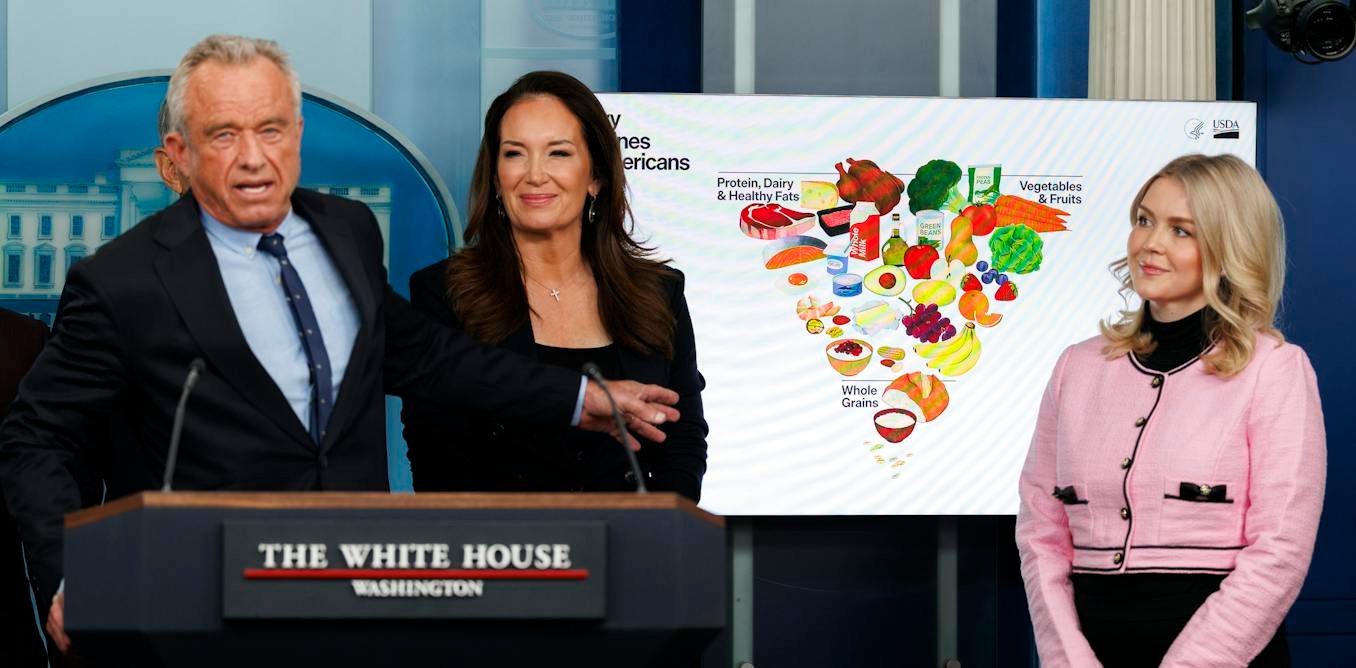
The US has unveiled a controversial new food pyramid that’s causing a stir among nutrition experts. It represents the latest Dietary Guidelines for Americans – advice on what types and quantities of food and drink make up a healthy diet.
But the Trump administration’s new guidelines differ in many ways from previous versions. Most striking is the moralising language about “real” food and a stark shift of responsibility onto individuals, with all consideration of health equity stripped away.
The change from the previous plate graphic to an inverted pyramid looks revolutionary at first glance. But dig deeper and the actual dietary advice hasn’t changed as much as the presentation suggests.
The new website is eye-catching, with dramatic language about “restoring common sense”. Yet many recommendations mirror the 2020–25 guidelines that came before.
Eating a variety of fruit and vegetables, aiming for five a day, limiting saturated fat to less than 10% of energy – these are all still there. So are being mindful of portion sizes, reducing processed foods, limiting refined sugars and prioritising whole foods.
Where things get contentious is the emphasis on animal fats and protein. Meats, full-fat dairy, butter and beef tallow – all
This contradicts established science. Saturated fats are known to increase heart disease and stroke risk, which is a leading cause of death in the US.
Doesn’t add up
Crucially, the guidelines don’t explain how people can eat these foods while keeping saturated fat below 10% of energy intake. The maths simply doesn’t add up.
Protein recommendations have doubled from 0.8g of protein per kilogram of body weight per day to 1.2–1.6g per kilogram of body weight per day. This follows social trends in protein popularity rather than nutritional need.
Adequate protein is important for muscle mass, blood sugar management and keeping hunger at bay. But this shift seems odd given that Americans are not under-consuming protein in the first place.
Many other contradictions are present too. The guidelines suggest flavouring meat and vegetables with salt while simultaneously restricting sodium – a component of salt.
Fibre and fibre-containing foods like pulses and legumes get barely a mention. There’s heavy emphasis on reducing highly processed foods, but no clear definition of what these include.
The alcohol advice is equally confusing. People are told to reduce intake without any guidance on how much is too much.
Perhaps most problematic is that the inverted pyramid image doesn’t match what’s written in the guidelines. Wholegrains sit at the narrow bottom, suggesting low consumption is recommended, but the text says two to four servings per day.
Meats and saturated fat sit at the top, implying high consumption is advised. As the pyramid is the primary visual tool for communicating these guidelines to the public, this confusion is deeply concerning.
HHS and USDA
It’s not just the content that’s changed – the entire process has been overhauled. The US government rejected the scientific report from independent experts that usually informs the guidelines. Instead, it hired a new group of scientists who chose not to consider any fields other than nutrition science.
International and US trends in dietary guidelines increasingly take a broader view, considering environmental impact, and whether people from all backgrounds can access, afford and prepare recommended foods.
This broader perspective acknowledges a harsh reality. In their current form, dietary guidelines have limited effect on what people actually eat.
A recent review of studies from 18 countries found that only 14% to 45% of people follow some or all of their country’s dietary recommendations.
The World Health Organization and many scientists have called for “food systems-based” dietary guidelines to address this. A food systems approach doesn’t just tell people what to eat. It recommends changes across all aspects of the food system – from production through to processing, distribution, preparation and consumption.
The new US guidelines, with their narrow focus and lack of clarity, will be difficult to implement. In any region where there’s an oversupply of high-calorie, low-nutrient foods and an undersupply of high-nutrient foods – such as fruit and vegetables – these guidelines are unlikely to influence what people actually eat.
What’s truly concerning is that these guidelines inform US government-funded food and nutrition programmes. That includes school meals, military and veteran meals, and other child and adult nutrition programmes. Through confusing and contradictory advice, the new guidelines have the potential to impede rather than promote the health of millions.
Other countries often take into account international practices when preparing their own dietary guidelines. However, it seems unlikely that they will follow this new direction from the US due to the confusing messaging, the inclusion of some questionable recommendations, and a lack of consideration of the broad range of factors that influence what people eat and drink.
