

Abstract
In parallel with the growing number of pets, interest in their proper nutrition is also increasing. Many alternative diets have become popular. In addition to home-prepared raw food, commercially available preprepared raw dishes have also been developed in recent years. According to publications from the last decade, many recipes for raw foods do not fulfill the definition of a complete and balanced diet. We determined the mineral composition of complete preprepared raw dishes (n = 33) available in Hungary and compared the results with the FEDIAF’s recommendations. Macroelements were determined via inductively coupled plasma optical emission spectrometry, and microelements and heavy metals were determined via inductively coupled plasma mass spectrometry. None of the foods were complete to all the macro- and microelements. Selenium was below the minimum recommended level in all foods. The lead levels were higher than permitted in two samples containing game meat, one of which was combined with salmon. In our research, none of the preprepared raw dishes covered the mineral requirements of dogs according to the FEDIAF recommendations. Our results are in accordance with the relevant literature, emphasizing the need for better quality control from regulatory authorities and increased awareness from the owners to ensure that their pets receive a complete diet.
Subjects
- Nutrition
- Risk factors
Introduction
The anthropomorphizing of dogs and cats is a common phenomenon today1. In addition, emerging trends in human dietetics–focusing on healthy ingredients, nutritional value, and quality–have also appeared in the pet food industry2. Schleicher et al. found that most pet owners (53.1%) consider eating healthily for themselves and their pets equally important, and 43.6% consider feeding their pets a healthy diet more critical than their diet does2. For humans, eating has a strong emotional and cultural symbolic value. Many people choose a certain diet for personal and ethical reasons. Many pet owners likely choose an alternative diet for their dogs because it creates a stronger emotional bond between them and their pets3. This may be one of the reasons why the use of a raw meat-based diet (RMDB) or biologically appropriate raw food (BARF) has become increasingly popular among pet owners in recent years. According to Morgan’s survey in the U.S., 67.3% of owners who feed their animals with a BARF diet are concerned with the safety of dry food and the quality control system used, and they do not trust the nutritional content of commercial foods. A total of 67.5% of them were fed raw to improve the skin and coat conditions, 66.5% were fed to improve the condition of the teeth, and 65.7% were fed to enhance the immune system of their pets. When asked why they chose to feed raw, the most popular answers were to achieve a “healthier” (77.4%) and “more natural” (71.2%) diet4. Many publications have investigated this area. The reputed benefits are rarely confident and often originate from low-quality studies, so they remain mainly anecdotal5,6. However, many publications collect data about the evidence of raw feeding-related health risks, which may affect either the animals or the owners7,8,9,10. These frequently mentioned factors include contamination with pathogens, parasites, and malnutrition6,8.
In addition to conventional, commercially available extruded dry and wet foods, there are many alternative options, e.g., raw food diets, vegetarian diets, and home-prepared cooked diets3. The feeding methods can be grouped on the basis of whether the ingredients used are raw or heat-treated, and whether the owners prepare them themselves or buy them preprepared and ready-made. The common expectation toward them is to be complete and balanced. According to the National Research Council (NRC), a complete animal feed can be consumed as the sole source of nutrition without leading to deficiency diseases11. According to Regulation (EC) No 767/2009 of the European Parliament and the Council, “complete feed means compound feed which, by reason of its composition, is sufficient for a daily ration”12. Both the NRC11 and the European Pet Food Industry (FEDIAF)13 make recommendations regarding the nutritional requirements of dogs and cats. “Nutrient requirements are established by gathering evidence of deficiency and toxicity at certain levels, and the values in between the minimum and maximum recommended levels represent a safe and adequate range of nutrient intake, which may vary according to the nutrient in question and diet composition”14.
Quantitative assessment can be performed with diet formulation software and laboratory analysis. Computer-based diet analysis is a rapid and simple method for recipe evaluation; however, it relies on nutrient databases of foods, whose values are not always established Laboratory measurements provide reliable and accurate results but are costly, time-consuming, and not practical15
Despite these clear clarifications, the scientific literature frequently reports nutritional deficiencies related to home-prepared foods. Stockman et al. analyzed 200 recipes, and 95% of which contained at least one essential nutrient at concentrations that did not meet the National Research Council (NRC) or Association of American Feed Control Officials (AAFCO) guidelines, and 83,5% had multiple deficiencies, according to the NRC15. Davies et al. analyzed the mineral content of complete dog and cat foods and compared it with the FEDIAF’s recommendations. 38% of dry foods and only 6% of wet foods were fully compliant16.
An increasing amount of research is being published on heavy metal contaminants in food intended for human consumption. Like human food, pet food can also contain them17,18,19. Food containing high concentrations of heavy metals can accumulate in the body and cause health problems. Some researchers have detected heavy metals in dog hair, kidneys, blood, and liver20,21. Dietary intake is the easiest contamination route and is therefore a particular problem in pet food production. Related to the heavy metals, there is no safe upper limit or maximum level in the NRC, AAFCO, or FEDIAF, but the FDA has recommended a maximum tolerable level14,19.
On this basis, both homemade and commercially available foods are often deficient in or overdosed with nutrients and minerals, and their completeness and balance are questionable. Foods made with inappropriate recipes can cause serious problems in the long term, especially if the animal eats the same type of improperly prepared food for a long period of time. In this case, the effects of certain deficiencies or excesses are most pronounced16. Many times, the raw and home-prepared diets based on generally available recipes are not complete. Our study aimed to investigate whether manufacturer-prepared raw dishes are reliable and have a complete composition of macro-and microminerals.
Results
Preprepared raw foods
We enrolled 33 preprepared raw diets in our investigation; they came from 6 different manufacturers: four used both mono- and mixed-protein sources, while one manufacturer used only mono-protein formulations, and one used only mixed-protein formulation. In total, the recipes contained 16 types of animal proteins. Beef was the most frequently used animal protein, occurring in 39.4% (n = 13/33) of the dishes, followed by rabbit and lamb (21.2% (n = 7/33) and 18.2% (n = 6/33) respectively), and turkey, chicken, and salmon with equal frequency (15.2%, n = 5/33).
Nutritional analyses
The metabolizable energy (ME) content is necessary for the comparison and evaluation of mineral content. The nutrient values determined in the nutritional analysis allowed the calculation of the ME. The average ME was 5514 kcal/kg (± 728, range: 3758–6631 kcal/kg DM, median: 5768 kcal/kg DM). The results of proximate analysis of preprepared raw dog foods can be found as Supplementary Table S1 online. Because of the high variability of the metabolizable energy content of the samples we transformed the measured values of the minerals from the “unit/kg dry matter” measurement unit into “unit/1000 kcal ME”.
Mineral analyses
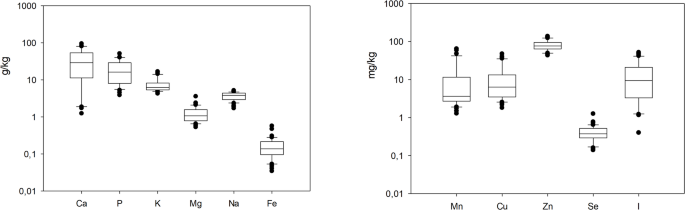
Figure 1 shows the results of the mineral analysis in “unit/kg dry matter”. The results of mineral analysis (units/kg dry matter) of preprepared raw foods can be found as Supplementary Table S2 online. The results of the mineral analysis (in 1000 kcal) of the 33 preprepared raw foods for healthy adult dogs in comparison with the FEDIAF minimum recommendations are listed in Table 1. For the comparison with the FEDIAF maximum levels the “unit/1000 kcal ME” was used for the macro minerals, and “mg/kg DM”- values were used for the evaluation of microminerals (Table 2). Calcium, phosphorus, and copper contents were higher than the FEDIAF recommendations in 45.5%, 36.4%, and 12.1% of the foods, respectively. The calcium-to-phosphorus (Ca: P) ratio was greater than 2:1 in 9 of the samples (27.3%). The total of 57.6% of the foods had iodine levels higher than the maximum recommended level. The selenium levels were below the minimum recommended level for all the products, and the sodium levels were within the normal range for all the samples. The percentage of the mineral supply of preprepared raw dog foods below the FEDIAF recommendations was also evaluated (Fig. 2).
The measured concentrations of the minerals in g/kg dry matter (left) and in mg/kg dry matter (right).
Errors
Figure 3 represents the type and number of errors related to the samples. The number of total errors was between 3 (1/33) and 8 (4/33, 3 out of 4 made by the same manufacturer) per product. All four samples had calcium, phosphorous, potassium, copper, zinc, selenium, and iodine concentrations outside the recommended range. A total of 66.7% of the samples contained at least 6 minerals in an inappropriate amount.
According to the manufacturers (Fig. 4), the median value of the total errors varied between 5 and 7 (1 manufacturer had 5, two had 6, one had 6.5 and two 7 total errors), and there was no significant difference between the manufacturers (Kruskal–Wallis chi-square = 9.3398, df = 5, p = 0.096). If we evaluated the total errors according to protein source groups, the mono-protein group median error was 6 (range: 4–8, SD ± 1.1), the median error was 5 in the mixed-protein group (range: 3–7, SD ± 1.4), and the Kruskal–Wallis test revealed a significant difference between them (chi–square = 5.3035, df = 1, p = 0.021).
Heavy metal analyses
We measured the concentrations of twelve different heavy metals in the raw food samples via an ICP-MS device. The results are given in Table 3. The results of mineral analysis (units/kg dry matter) of preprepared raw foods per sample can be found as Supplementary Table S3 online. The maximum tolerable level (MTL) recommended by the FDA19 was used for the evaluation. Barium, cadmium, titan, and vanadium were detected in all the samples, and the least frequently detected element was tin (6.1%; n = 2). All the levels of the heavy metals were below the maximum tolerable level, except the lead. We found that lead was higher than the permitted level in two samples (6.1%), one of which was a game (deer and roe deer) meat-containing food and the other a deer-salmon-beef mixture (6 times and 23 times higher than the safe level, respectively).
Discussion
None of the foods could be considered as complete concerning the macro- and microelements. All the investigated preprepared raw dishes had at least three minerals above or below the FEDIAF’s recommendation.
On the basis of these factors there is no difference in the reliability of the manufacturers, all of them should have to improve their performance. However, the dishes that used more than one animal species in their recipe seemed to be more reliable concerning their mineral contents.
We found a greater prevalence of micro errors than macro errors (median values of 4 and 2, respectively). This is in harmony with the literature, where the inappropriateness of microelements is dominant14,15,16,22,23.
Like Pedrinelli et al.14, we also transformed the measured value from mg/kg DM to mg/1000 kcal, because the preprepared raw foods had very variable metabolizable energy contents, 93,9% had MEs greater than 4000 kcal/kg DM. Without the exact knowledge of the ME content of the food, it is not possible to correctly compare the measured values with the FEDIAF’s recommendations13. This is because a dog’s daily ration depends on its energy requirement, so the energy density of the food determines the amount of nutrient uptake24. It is mandatory to claim a feeding guide on the label of pet foods12. In our investigation, only 4 of the 6 manufacturers provided clear feeding instructions, and all the manufacturers used the same text for all their foods and did not consider the different ME contents. If these preprepared raw dishes were fed according to their label instructions (2% of body weight), then it would lead to 134–237% ME overconsumption for a 15 kg dog. This increases the risk of obesity, and to avoid overfeeding the daily ration should be decreased, leading to malnutrition.
The incidence of preprepared raw foods with mineral levels below the FEDIAF minimum recommendation was high. Potassium
Box-plot of the percent of the mineral supply of preprepared raw foods intended for healthy adult dogs with mineral levels below the FEDIAF recommendations. The horizontal lines represent median values.
deficiency was the most frequently observed from the macroelements (60.6%), but if we feed them according to the labels’ instructions, 32/33 do not meet the potassium requirement of a 15 kg dog13. In dogs, the consequences of reduced potassium intake can include hypokalemia and hypotension25, anorexia, lethargy, heart and kidney lesions, and emaciation26, and can alter renal perfusion in the short term14. Streiff et al. also reported potassium concentrations below the AAFCO recommendation in home-prepared foods22 and in Pedrinelli’s experiment, 95% of the homemade dog foods presented potassium levels below the FEDIAF recommendation14.
Selenium was below the minimum recommended level in all the foods, and this finding was in accordance with the results of Pedrinelli14 and Sgorlon27. However, Davies et al. repotred that selenium concentrations were higher than permitted in 76% of commercial wet foods, with seven samples containing three times the permitted maximum16. Both used the FEDIAF as a reference guideline. Selenium was the most deficient among the tested foods; only 4% − 48.5% of the minimum requirement was covered by the concentrations measured in our samples. In the absence of selenium, there is a risk of muscular dystrophy, renal mineralization, reproductive failure, subcutaneous edema, and decreased appetite. A diet containing less than 0.12 mg/kg selenium on a dry matter basis causes reduced hair growth28; however, the dishes tested in our research all had higher concentrations. The selenium requirement is reduced by vitamin E26; however, we have no information about the vitamin levels of these preprepared raw foods.
Zink, manganese, and copper were frequently detected (75.8%, 69.7%, and 63.6%, respectively) at levels below the recommended intake. If a 15 kg dog is fed according to the instructions, none of the examined foods will cover the minimum zinc demands. Stockman et al. investigated custom-prepared recipes and reported that, compared with the NRC, zinc, copper and calcium were the most commonly deficient minerals (69%, 54% and 35% respectively)15. In homemade diets, mineral analysis revealed lower zinc and copper levels than those recommended by the AAFCO22. Pedrinelli analyzed Portuguese recipes with a commercial software package and compared the results to the FEDIAF’s recommendation. The most common mineral deficiencies were zinc (75,6%) and copper (85,4%)23. Zinc deficiency-related symptoms affect mainly the skin, causing hair depigmentation, parakeratosis, and alopecia, but conjunctivitis, vomiting, and impaired reproduction have also been described26. Excess dietary calcium can inhibit the zinc gastrointestinal absorption, and high copper can reduce the bioavailability of zinc16. Zinc availability is also decreased by phosphate, iron, and cadmium26. Fifteen preprepared raw foods (45.5%) had calcium levels above the maximum recommendation (the range of excess varies between 101 and 394%). Four dishes contained higher copper concentrations than the allowed maximum, and two also had high calcium contents. There were 5 foods with high calcium and phosphorus contents and low zinc levels and one of them even had a copper content above the maximum value. The combination of these effects may further impair the utilization of zinc in the affected foods.
Manganese activates enzymes involved in collagen synthesis, thus maintaining the integrity of connective tissues (muscle,
Types and numbers of errors associated with the different raw foods. It also shows the manufacturers. The last row represents the number of foods with appropriate concentrations of a certain mineral. The green square indicates the appropriate concentration, yellow below the minimum, and rose above the maximum of the FEDIAF recommendation.
Boxplot of the number of total errors according to the manufacturers and the group of mono- vs. mixed protein. The horizontal lines represents the median value of the total errors.
bone, and cartilage), in blood formation, lipid metabolism, and hormone balance. Its deficiency can lead to fatty liver and crooked legs. Excessive levels of phosphorus, cobalt, and iron can reduce its absorption26. According to our results, 23 dishes (69.7%) had low manganese concentrations and 11 had phosphorus levels above the recommended FEDIAF maximum. This can negatively influence the utilization of manganese to increase the risk of manganese deficiency. Fortunately, magnesium can be used as a partial substitute, with little loss in enzymatic activity26. There are six foods with low manganese but normal magnesium concentrations, and there are no dishes with high phosphorus and low magnesium and manganese levels, which can explain why we cannot observe manganese deficiency frequently.
Copper deficiency can also cause hair/coat instability16, hair depigmentation, reproductive failure, anemia, neuromuscular disorders, bone lesions, and hyperextension of the distal forelimbs26. The bioavailability of copper from food is highly variable and affected by interactions with calcium, zinc, iron, and phytates, resulting in the formation of unabsorbable complexes26. There were ten preprepared raw foods with high calcium and low copper concentrations; however, half had low zinc levels, and the possibility of complex formation was moderated. The concentration of copper in food also depends on the ingredients used. The bioavailability is limited from pork liver, but the liver of chicken, sheep, turkey, and beef are good sources (with relative bioavailability of 116, 113, 83, and 82%, respectively)29. Eight raw foods named the liver on their label (four contained beef, two rabbit, one duck and one deer and roe deer), and 23 named only offal without further specification. Among the eight foods for which the liver was accurately identified as an ingredient, only one contained copper in the reference range, and the rest had concentrations below the minimum limit. In 1997, the AAFCO elevated its minimum dietary copper recommendation, so manufacturers also had to increase it. The pet food industry has changed the added premixes (copper sulfate instead of copper oxide), and commercial foods are formulated with a high ratio of animal-originated ingredients and use organ meat to meet the new copper recommendation30. In a retrospective case-control study, Johnston et al. reported a tendency toward elevated hepatic copper levels in dogs31. According to Center et al., there is an association between hepatic injury and changes in the type of copper used in commercial foods. They suggest revising the current copper minimum recommendation30. If this happens, we also have to re-evaluate our results related to suspected copper deficiency.
Over half (57.6%) of the analyzed diets had iodine concentrations above the FEDIAF recommended maximum level. The range of the surplus supply was 119–471%. The suspected explanation for this elevated iodine level is that the meat used for the food was contaminated with thyroid glands. Many publications have measured the thyroid concentration of food to confirm the diagnosis of alimentary hyperthyroidism32,33. The typical signs are the following: weight loss despite a good appetite, polydipsia, polyuria, patchy alopecia, and aggressive behavior34. Frequently, the basic materials of raw diets are the body parts of mainly ruminants, and they also include the neck with the trachea and the thyroid gland. Gastric acid does not destroy thyroid hormones, and they can be absorbed and act similarly to levothyroxine. This leads to alimentary hyperthyroidism34. One study revealed a relationship between a raw diet and epileptic seizures due to dietary hyperthyroidism (food was confirmed to contain detectable levels of total thyroxine)35. Broome et al. reported elevated thyroxine concentrations in commercially available meat-based dog foods and treats, and the dogs that were fed these foods presented signs of hyperthyroidism33. Diagnostic confirmation of food-induced thyrotoxicosis can be achieved by food change, which is followed by fast and full remission of signs32,36. The elevated iodine level we measured can be a sign of contamination of the thyroid glands37 and the consumption of such preprepared raw food increases the risk of alimentary hyperthyroidism.
The analyzed preprepared raw foods frequently have calcium and phosphorus concentrations above the FEDIAF maximum recommendation (45.5 and 36.4%, respectively). Both minerals were elevated in twelve foods (36.4%). In the literature, homemade recipes have low calcium14,15,23 and phosphorus14 levels. In our investigation, the Ca: P ratio was lower than 1:1 in five feeds and higher than 2:1 in 9 samples. Streif et al. reported a Ca: P ratio below the recommended intake in home-prepared and commercial diets22, and Pedrinelli et al. reported a Ca: P ratio below the FEDIAF recommendation in 76% of the investigated home-prepared foods14. Alimentary secondary hyperparathyroidism (ASHP) is caused by a low Ca: P ratio and calcium deficiency14,26,38,39. The manufacturers of these preprepared raw dishes overcompensated the well-known calcium and phosphorous deficiency. The consequences of excess dietary calcium can include decreased appetite, nephrosis, enlarged costochondral junctions, lameness, urolithiasis, and nephrosis, and it can decrease the absorption of zinc, iron, and copper. A surplus of phosphorus can lead to bone loss, calcification of soft tissues, ASHP, uroliths, and weight loss26.
The most reliable minerals in our study were sodium, iron, and magnesium. All the samples contained barium, cadmium, titan, and vanadium but were below the FDA19 maximum tolerable level (MTL). Tin occurred at the lowest frequency (6.1%). The average number of heavy metals detected in the dishes was 7 (with a range of 4–11). Zaflon et al. analyzed commercial pet foods and observed mercury, lead, and vanadium in their samples; however, their concentrations exceeded the MTL (100, 81 and 75%, respectively)17. In another study, mercury, vanadium, lead, and cobalt were the heavy metals in home-prepared foods with concentrations above the MTL (71, 53, 27 and 4%, respectively)14. We can conclude that the investigated group of preprepared raw dishes was not exposed to severe heavy metal loads except lead. We detected lead in seven foods, and it was the only heavy metal above MTL; this occurred in 2 preprepared raw foods. The one containing only game meat contained a lead concentration that was 6 times greater, whereas the one containing game, salmon and beef had a lead concentration that was 23 times greater than the permitted level. The lead intake of a 15 kg dog feeding as per label instructions would be 0.22 mg/kg and 1.93 mg/kg body weight, respectively. The experimental data indicate that 1 mg lead/kg body weight for ten days is the lowest observed toxic level in dogs40. Based on these findings, the latter food poses a long-term threat to animal health. The signs of lead poisoning are diverse: gastrointestinal and neurological signs are the most commonly observed, but bone, renal, cardiovascular, hematological effects and arterial hypertension can all appear14,40,41. One study stated that lead absorption is enhanced in high-fat and low-calcium diets42. The only game containing food had a calcium level below the recommended level, but the other with multiple animal sources and higher lead level had a calcium above the FEDIAF maximum recommendation; this fact may act against lead absorption in this feed. Many publications warn that lead-shot games have greater lead content40,43,44. The trimmings of wound channels caused by lead bullets are not human-grade parts of the games, so they can be a less expensive source of animal-originated feed ingredients. Based on this game containing foods should be fed with caution.
Conclusion
Home-prepared raw diets are frequently imbalanced and not complete, so they can act as risk factors for canine health. Pet owners have a reasonable expectation that when they buy a commercially available preprepared raw food labeled by manufacturers as complete food, it should meet FEDIAF regulations concerning mineral content. In the present study, none of the evaluated foods met all the recommendations for macro- and microelements. Concerning heavy metals, only lead exceeded the maximum tolerated level and was present in two foods, but at least four heavy metals could be detected. In recipe formulations, manufacturers and their nutritional experts should include safety margins for mineral and trace elements because of the variable bioavailability of nutrients depending on their source. It is not enough to evaluate the deficiencies and excesses of minerals; the interactions between them must also be taken into consideration to produce a safe and reliable product. Another critical part is the feeding guide because even a well-formulated recipe will not provide a sufficient amount of nutrients if it is not tailored accordingly. The task of science is to facilitate the incorporation of its findings into daily practice, monitor how these findings are implemented and draw attention to cases where inconsistencies are detected. The authors aim to increase awareness of the necessity of developing and applying a control system that considers the hazardous critical points in the preprepared raw food manufacturing sector.
Distribution of mono- and mixed protein foods according to the manufacturers.
Methods
Sample collection
We purchased commercially available preprepared raw foods intended for healthy adult dogs. All the samples were frozen and labeled as complete and balanced. At the time of the experiment, six manufacturers’ products were available in the Hungarian market (A, B, C, D, E, F), 16 samples were produced locally and 17 were imported. We evaluated thirty-three different raw foods, twenty-one containing only one type of animal protein (mono) and twelve containing more than one type of animal protein (mix). Both contained skeletal muscle and offal. The distribution of raw food types according to the manufacturers is presented in Fig. 5. The mono-protein products used the following protein sources: cattle, lamb, rabbit, horse, goat, duck, goose, turkey, and chicken. In addition to the sources listed above, the mixed-protein samples also contained the following: roe deer, deer, salmon, sardines, moose, and reindeer. The ingredients and origins of preprepared raw dog foods can be found as Supplementary Table S4 online.
Proximate analyses
After thawing, the samples were dried in a 55 °C oven for 36 h and then homogenized by grinding at the Laboratory of Nutrition and Clinical Dietetics Department of the Institute of Animal Breeding, Animal Nutrition and Laboratory Animal Science of the University of Veterinary Medicine of Budapest. The dry matter content was determined after 4 h of drying in a drying oven at 105 °C. The crude ash content was measured after incineration at 550 °C, the crude protein content was analyzed via the Kjeldahl method, and the crude fat content was measured via the Soxhlet method. The fiber content of the samples was below the measurement range, so the values indicated on the product labels were used in the calculations. The nitrogen-free extract (NFE) and metabolizable energy (ME) contents were determined via calculations. We used the method from the National Research Council (NRC) to calculate the NFE (NFE = 100 – % crude protein – % crude fat – % crude fiber – % moisture – % ash)11[,24. Because these are highly digestible foods of animal origin and vegetables in their natural state, we used the Atwater equation for the prediction of ME content: ME (kcal/kg) = 10 x [(9 kcal/g x % crude fat) + (4 kcal/g x % crude protein) + (4 kcal/g x % nitrogen-free extract)]13,24. To convert unit/kg DM to unit/1000 kcal ME, we used the following formula: (1000 x unit/kg DM)/ME of 1 kg dry matter.
Mineral and heavy metal analyses
For mineral analyses, 500 mg samples were put into a CEM MARS XPreSS Teflon vessel, and then 5 ml of hydrogen peroxide and 5 ml of nitric acid were added. Digestion was performed in a 40-place CEM MARS6 microwave digester (CEM Corporation, Matthews, North Carolina, USA) (parameters: heating for 35 min; temperature, 200 °C; for 50 min; power, 1700 W). After digestion, the contents of the vessels were washed into 50 ml polypropylene (PP) tubes (Deltalab, Rubí Barcelona, Spain), which were subsequently filled with 25 ml of deionized water. Fivefold dilutions of the samples were performed in 12 ml PP tubes (Deltalab, Rubí Barcelona, Spain), and different internal standards were subsequently added to the samples via different measurement techniques. For inductively coupled plasma-optical emission spectrometry (ICP-OES), 100 µl of 100 µg/ml yttrium solution was used; for the inductively coupled plasma optical mass spectrometry (ICP-MS), 4 ml of ethanol and 100 µl of internal standard solution containing 1 µg/ml bismuth, germanium, and indium were used. 0.15 M hydrochloric acid solution was used to clean the Teflon vessels between the digestion rounds. Quality control standards were prepared from bovine liver (Standard Reference Material 1577c) obtained from Merck KGaA (Darmstadt, Germany). The argon gas used was of 4.8 purity and was purchased from Messer Hungarogaz Ltd. (Budapest, Hungary). These analyses were performed by the Atomic Spectroscopy Laboratory of the Department of Animal Hygiene, Herd Health and Mobile Clinic of the University of Veterinary Medicine of Budapest.
Statistical analyses
The frequencies (%) of minerals were used for descriptive statistics. Prior to the inductive analyses, we used the Shapiro-Wilk test to test the normality of the variables, as was done for the quantile–quantile plots. We used Student’s t-test for normally distributed variables to evaluate the significant effect between the measured mineral values and the FEDIAF nutritional recommendation as reference values. In the case of nonnormal distribution, the Wilcoxon test was used. To evaluate the multiple comparisons between the number of inappropriate measured values and the manufacturer’s references, we used ANOVA for the normally distributed values, whereas the Kruskal–Wallis test was utilized in the case of nonnormality. The alpha (statistically significant) value was set at p < 0.05. All analyses were carried out in R 4.2.3 with R Commander 2.9–045.
During the analysis, the FEDIAF recommendations for active adult dogs for 1000 kcal of ME were used as reference values for the recommended minimum parameter comparison. The maximum allowed limits for the macro elements (calcium, phosphorus, potassium, magnesium, and sodium) were also derived from this, whereas those for the trace elements (manganese, iron, copper, zinc, selenium, iodine) were the values defined as legal limits in the FEDIAF “unit/100 g dry matter” Table13. The maximum tolerable level (MTL) recommended by the FDA is considered for analyses of heavy metals14,19.
The results outside the reference limits were considered “errors”. The inadequacies of macro- and microelements were named “macro errors” and “micro errors”, respectively, and their sum was “total errors”.
Data availability
The datasets used and/or analysed during the current study are available from the corresponding author on reasonable request.
References
Mota-Rojas, D. et al. Anthropomorphism and its adverse effects on the distress and welfare of companion animals. Animals11, 3263 (2021).
Schleicher, M., Cash, S. B. & Freeman, L. M. Determinants of pet food purchasing decisions. Can. Vet. J.60, 644 (2019).
Michel, K. E. Unconventional diets for dogs and cats. Vet. Clin. Small Anim. Pract.36, 1269–1281 (2006).
Morgan, S. K., Willis, S. & Shepherd, M. L. Survey of owner motivations and veterinary input of owners feeding diets containing Raw animal products. PeerJ5, e3031 (2017).
Morelli, G., Bastianello, S., Catellani, P. & Ricci, R. Raw meat-based diets for dogs: survey of owners’ motivations, attitudes and practices. BMC Vet. Res.15, 1–10 (2019).
Freeman, L. M., Chandler, M. L., Hamper, B. A. & Weeth, L. P. Current knowledge about the risks and benefits of Raw meat–based diets for dogs and cats. J. Am. Vet. Med. Assoc.243, 1549–1558 (2013).
Lambertini, E., Buchanan, R. L., Narrod, C. & Pradhan, A. K. Transmission of bacterial zoonotic pathogens between pets and humans: the role of pet food. Crit. Reviews Food Sci. Nutr.56, 364–418 (2016).
van Bree, F. P. et al. Zoonotic bacteria and parasites found in Raw meat-based diets for cats and dogs. Vet. Rec. 182, 50–50 (2018).
Davies, R. H., Lawes, J. R. & Wales, A. D. Raw diets for dogs and cats: a review, with particular reference to Microbiological hazards. J. Small Anim. Pract.60, 329–339 (2019).
Hajek, V., Zablotski, Y. & Kölle, P. Computer-aided ration calculation (diet check munich©) versus blood profile in Raw fed privately owned dogs. J. Anim. Physiol. Anim. Nutr.106, 345–354 (2022).
Council, N. R., Studies, L., Animal Nutrition, C., Dog, S. & Nutrition, C. onon Nutrient requirements of dogs and catsNational Academies Press, (2006).
UNION, P. Regulation (ec) 767/2009 of the European Parliament and of the Council of 13 July 2009 on the placing on the market and use of feed. Off J. Eur. Union. L229 52, 1 (2009).
FEDIAF. Nutritional Guidelines for Complete and Complementary Pet Food for Cats and Dogs (Fédération Européenne de l’Industrie des Aliments pour Animaux Familiers, 2024).
Pedrinelli, V. et al. Concentrations of macronutrients, minerals and heavy metals in home-prepared diets for adult dogs and cats. Sci. Rep.9, 13058 (2019).
Stockman, J., Fascetti, A. J., Kass, P. H. & Larsen, J. A. Evaluation of recipes of home-prepared maintenance diets for dogs. J. Am. Vet. Med. Assoc.242, 1500–1505 (2013).
Davies, M. et al. Mineral analysis of complete dog and Cat foods in the Uk and compliance with European guidelines. Sci. Rep.7, 17107 (2017).
Zafalon, R. V. A. et al. Toxic element levels in ingredients and commercial pet foods. Sci. Rep.11, 21007 (2021).
Macías-Montes, A. et al. Nutritional evaluation and risk assessment of the exposure to essential and toxic elements in dogs and cats through the consumption of pelleted dry food: how important is the quality of the feed? Toxics9, 133 (2021).
FDA. Target Animal Safety Review Memorandum (U. S. Food and Drug Administration – (Center for Veterinary Medicine, 2011).
Serpe, F. et al. Levels of heavy metals in liver and kidney of dogs from urban environment. Open. Veterinary J.2, 15–18 (2012).
Park, S., Lee, M. & Kim, S. Studies on cd, pb, hg and cr values in dog hairs from urban Korea. Asian-australasian J. Anim. Sci.18, 1135–1140 (2005).
Streiff, E. L. et al. A comparison of the nutritional adequacy of home-prepared and commercial diets for dogs. J. Nutr.132, 1698S–1700S (2002).
Pedrinelli, V., de Gomes, O. S., Carciofi, A. C. & M. & Analysis of recipes of home-prepared diets for dogs and cats published in Portuguese. J. Nutritional Sci.6, e33 (2017).
Ramsey, J. J. Determining energy requirements. In: Fascetti, A. J., Delaney, S. J., Larsen, J. A. & Villaverde, C. (eds) Applied Veterinary Clinical Nutrition, 2nd edn, 29–57. Wiley Blackwell, Hoboken, NJ (2024).
Delaney, S. J. & Fascetti, A. J. Basic nutrition overview. In: Fascetti, A. J., Delaney, S. J., Larsen, J. A. & Villaverde, C. (eds) Applied Veterinary Clinical Nutrition, 2nd edn, 8–28. Wiley Blackwell, Hoboken, NJ (2024).
Wedekind, K. J., Yu, S., Kats, L., Paetau-Robinson, I. & Cowell, C. S. Micronutrients: minerals and vitamins. Small Anim. Clin. Nutr.5, 107–148 (2010).
Sgorlon, S., Sandri, M., Stefanon, B. & Licastro, D. Elemental composition in commercial dry extruded and moist canned dog foods. Anim. Feed Sci. Technol.287, 115287 (2022).
Yu, S., Wedekind, K., Kirk, C. & Nachreiner, R. Primary hair growth in dogs depends on dietary selenium concentrations. J. Anim. Physiol. Anim. Nutr.90, 146–151 (2006).
AOYAGI, S., BAKER, D. H. & WEDEKIND, K. J. Estimates of copper bioavailability from liver of different animal species and from feed ingredients derived from plants and animals. Poult. Sci.72, 1746–1755 (1993).
Center, S. A. et al. Is it time to reconsider current guidelines for copper content in commercial dog foods? J. Am. Vet. Med. Assoc.258, 357–364 (2021).
Johnston, A. N., Center, S. A., McDonough, S. P., Wakshlag, J. J. & Warner, K. L. Hepatic copper concentrations in Labrador retrievers with and without chronic hepatitis: 72 cases (1980–2010). J. Am. Vet. Med. Assoc.242, 372–380 (2013).
Isidori, M., Corbee, R. J. & Kooistra, H. S. Food-induced thyrotoxicosis in a dog. Vet Rec Case Reports12, e975 (2024).
Broome, M. R., Peterson, M. E., Kemppainen, R. J., Parker, V. J. & Richter, K. P. Exogenous thyrotoxicosis in dogs attributable to consumption of all-meat commercial dog food or treats containing excessive thyroid hormone: 14 cases (2008–2013). J. Am. Vet. Med. Assoc.246, 105–111 (2015).
Köhler, B., Stengel, C. & Neiger, R. Dietary hyperthyroidism in dogs. J. Small Anim. Pract.53, 182–184 (2012).
Foreman, M. Dietary hyperthyroidism in a dog with epileptic seizures. Companion Anim.28, 122–124 (2023).
Cornelissen, S. et al. Dietary hyperthyroidism in a rottweiler. Vlaams Diergeneeskundig Tijdschrift. 83, 306–311 (2014).
Zeugswetter, F., Vogelsinger, K. & Handl, S. Hyperthyroidism in dogs caused by consumption of thyroid-containing head meat. Schweizer Archiv für Tierheilkunde. 155, 149–152 (2013).
Nowak, L., van Loon, S., Hagen-Plantinga, E. & Bergknut, N. A case series of four dogs presenting with neurological deficits due to suspected nutritional secondary hyperparathyroidism after being fed an exclusive diet of Raw meat. Animals14, 1783 (2024).
Verbrugghe, A. et al. Metabolic bone disease and hyperparathyroidism in an adult dog. Vlaams Diergeneeskundig Tijdschrift. 80, 61–68 (2011).
Høgåsen, H. R., Ørnsrud, R., Knutsen, H. K. & Bernhoft, A. Lead intoxication in dogs: risk assessment of feeding dogs trimmings of lead-shot game. BMC Vet. Res.12, 1–8 (2016).
Bates, N. Lead toxicosis in cats and dogs. Companion Anim.23, 674–682 (2018).
Hamir, A., Sullivan, N. & Handson, P. Tissue lead distribution and pathological findings in lead exposed dogs maintained on fat and calcium modified diets. Br. Vet. J.144, 240–245 (1988).
De Nadai Fernandes, E. A., Elias, C., Bacchi, M. A. & Bode, P. Trace element measurement for assessment of dog food safety. Environ. Sci. Pollut Res.25, 2045–2050 (2018).
Pain, D. J., Green, R. E., Bates, N., Guiu, M. & Taggart, M. A. Lead concentrations in commercial dogfood containing pheasant in the Uk. Ambio52, 1339–1349 (2023).
Team, R. C. R: A Language and Environment for Statistical Computing (R Foundation for Statistical Computings, 2023).
Acknowledgements
This study was supported by the Normative Research Funding Committee and the Strategic Research Fund of the University of Veterinary Medicine Budapest (Grant No. SRF-001.).
Authors and Affiliations
Contributions
L.M. and O.K. conceived the concept of the study. Laboratory analyses were performed by J.K., Á.F.N., and B.B. Z.E. participated in the statistical analysis. L.M. and O.K. participated in the drafting of the manuscript. Z.E., Á.F.N., B.B. and ZS.W. carried out the manuscript’s critical revision for important intellectual content. All authors read and approved the final manuscript.
Ethics declarations
Competing interests
The authors declare no competing interests.
Additional information
Publisher’s note
Springer Nature remains neutral with regard to jurisdictional claims in published maps and institutional affiliations.
Supplementary Information
Below is the link to the electronic supplementary material.
Rights and permissions
Open Access This article is licensed under a Creative Commons Attribution-NonCommercial-NoDerivatives 4.0 International License, which permits any non-commercial use, sharing, distribution and reproduction in any medium or format, as long as you give appropriate credit to the original author(s) and the source, provide a link to the Creative Commons licence, and indicate if you modified the licensed material. You do not have permission under this licence to share adapted material derived from this article or parts of it. The images or other third party material in this article are included in the article’s Creative Commons licence, unless indicated otherwise in a credit line to the material. If material is not included in the article’s Creative Commons licence and your intended use is not permitted by statutory regulation or exceeds the permitted use, you will need to obtain permission directly from the copyright holder. To view a copy of this licence, visit http://creativecommons.org/licenses/by-nc-nd/4.0/.
About this article
Cite this article
Moravszki, L., Krizsán, J., Freiler-Nagy, Á. et al. Assessment of mineral adequacy in preprepared raw dog foods labeled as complete.
Sci Rep15, 43447 (2025). https://doi.org/10.1038/s41598-025-27388-w
Version of record:09 December 2025
DOI
:https://doi.org/10.1038/s41598-025-27388-w
