
Matt Damon has nothing but words of praise for the Vancouver stuntwoman who doubled for him in this summer’s blockbuster, The Odyssey. Sure, some critics have thumbed their noses, but the reviews are mostly positive, and if you look at it as another example of Christopher Nolan proving why storytelling is important, you’ll get the whole drift.
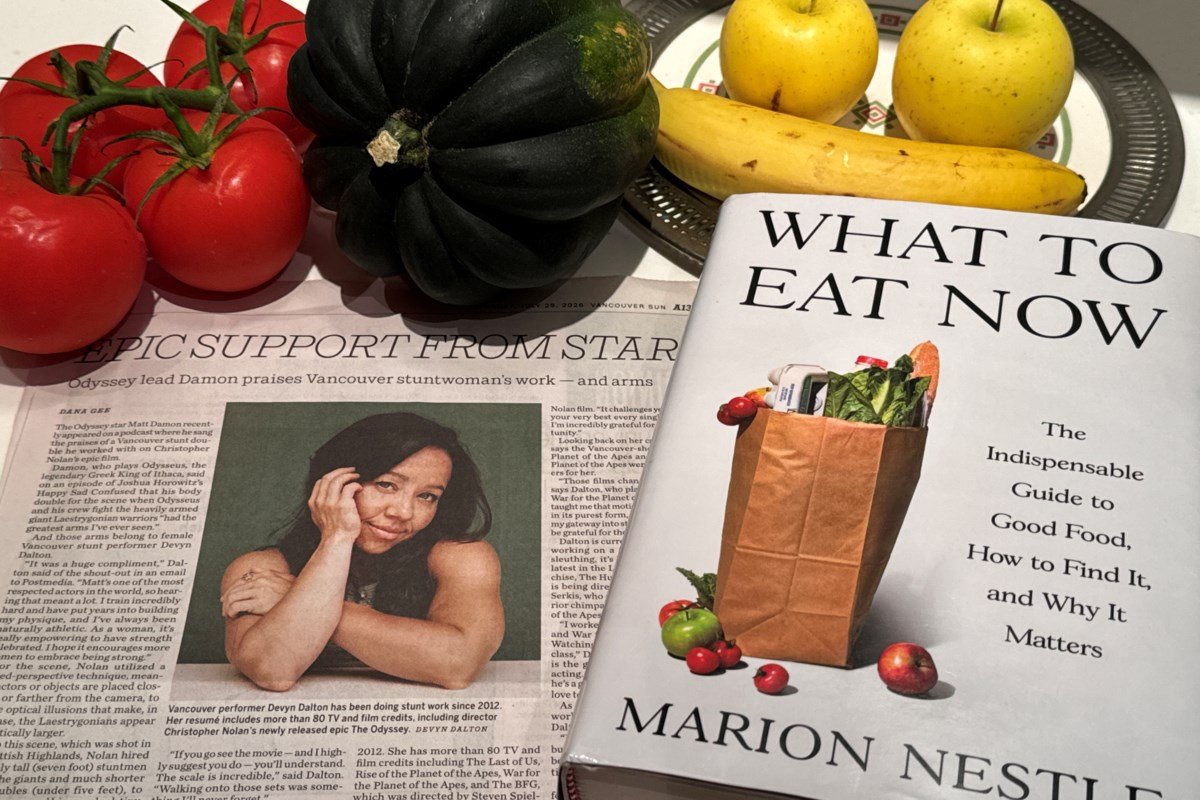
But there’s no equivocating about Damon’s high praise for Devyn Dalton, the Vancouver stuntwoman who doubled for him in the scene where Damon, as Odysseus, and his gang fight the Laestrygonians—a tribe of man-eating giants in Greek mythology. She has “the greatest arms I’ve ever seen,” says Damon.
Ironically, the handy-dandy bookmark keeping my place in Marion Nestle’s latest book, What to Eat Now: The Indispensable Guide to Good Food, How to Find It, and Why It Matters, is a Vancouver Sun feature on Dalton by longtime reporter and fellow Langara j-school alumna, Dana Gee. She details how Devyn has been doing stunt work since 2012, and from the Sun’s photo you can easily see just how strong and healthy she is. Made to last, like Marion Nestle.
What to Eat Now is a classic, just like The Odyssey and Nestle herself—a molecular biologist and longtime professor of nutrition, food studies and public health at New York University who’s been highly regarded for decades as one of the most resilient, outspoken nutritionists in the world.
Besides being totally down-to-earth, she’s also a powerful political activist, digging deep into how and why it’s critical to make “good and delicious” food choices, for ourselves, our families, and especially our broader communities.
“Fighting the trillion-dollar food industry” is how she puts it. Pretty much like fighting a tribe of human-eating giants, I’d say. Like the widespread confectionery fraud with food corps complicit in everything from false labelling to substituting crappy sweeteners like glucose-fructose for real honey or maple syrup.
In fact, Nestle points out that the broader issue of economically motivated food fraud (such as diluting pure virgin olive oil with cheap vegetable oil then selling it as pure olive oil, which made headlines years ago) is so common, America’s Food and Drug Administration has its own page on it. Experts estimate food fraud impacts at least one per cent of the global food industry, to the tune of US$10-15 billion a year. Some think the high-jacked profits could be as much as US$40 billion annually.
Nestle’s original What to Eat was first published in 2006, round about when I started this little food column. Nestle has updated and reissued her epic What to Eat Now some 20 years later after it dawned on her during COVID’s early days in 2020 how much the food industry and food choices changed over time. For one, the industry is much more consolidated now, with the top four U.S. grocery chains, like Walmart and Costco, controlling half or more of all U.S. food sales. I bet that might also echo here.
Then there’s online shopping and the ultra-processed food epidemic, which has resulted in things like the number of kids and teens aged five to 19 living with obesity globally quadrupling since 1990.
I love how wide Nestle’s reach is. For instance, What to Eat Now features entire chapters on foods just for kids and on pet food, including easy recipes for making your own that’s way healthier and cheaper than the commercial versions in the inner aisles of your local supermarket. Her 15-book repertoire includes two entire books on pet food and the industry controlling it: Pet Food Politics: The Chihuahua in the Coal Mine and Feed Your Pet Right co-authored with Malden C. Nesheim.
Then there’s another story, or at least a chapter, where she describes all the complexity and planning involved in the prime real estate of the supermarket to lure us hapless, daunted shoppers into those middle aisles where we’ll see—and maybe buy more of—the 30,000 to 60,000 items on offer, especially the ultra-processed cereals, cookies, snacks and all the other overpriced, empty-calorie crapola.
I also love how simple and practical her advice is, which pretty much echoes that other great food writer, Michael Pollan, in his best-seller In Defense of Food: An Eater’s Manifesto: “Eat food, not too much, mostly plants.” Nestle’s take: some foods are healthier than others, so eat fruits, veg, nuts and beans, not that ultra-processed stuff in those human-eating supermarket giants; whole grains, not refined grains; and water or 100-per-cent juices, not sugar- or artificially-sweetened drinks.
In a nutshell: “Delicious food is easy—good ingredients, well prepared.”
So what does 90-year-old Nestle eat? If you want to try the Washington Post, a 2025 article outlines her diet: Basically, not too much and mostly plants: Oatmeal or unsweetened shredded wheat and coffee with milk for brekkie; then lots of simple whole foods for lunch and dinner, like salads, eggs, greens and crackers.
The Post has a deal on right now—a buck for a month. I know, I know, we all have issues with that Laestrygonian, Jeff Bezos, who now owns it, but WaPo still has some fine reporters thanks to the legacy of former publisher Katharine Graham—another strong woman with her ethics in the right place.
Connecting with Marion Nestle
To dive deeper into Marion Nestle’s amazing work, sign up for her e-newsletters at Food Politics. What to Eat Now is available to buy online, or borrow it for free at many public libraries. Unfortunately, none in Sea to Sky have it yet, but Whistler’s library does have a copy of The New Mediterranean Diet Cookbook: A Delicious Alternative for Lifelong Health, which Nestle contributed to. She’s also interviewed in the documentary In Organic We Trust, available at Squamish’s library. n
Glenda Bartosh is an award-winning journalist who urges you to support real food, and real people reporting real news everywhere, includingPique, especially given National Newspaper Week in Canada — the first full week in October every year.
