

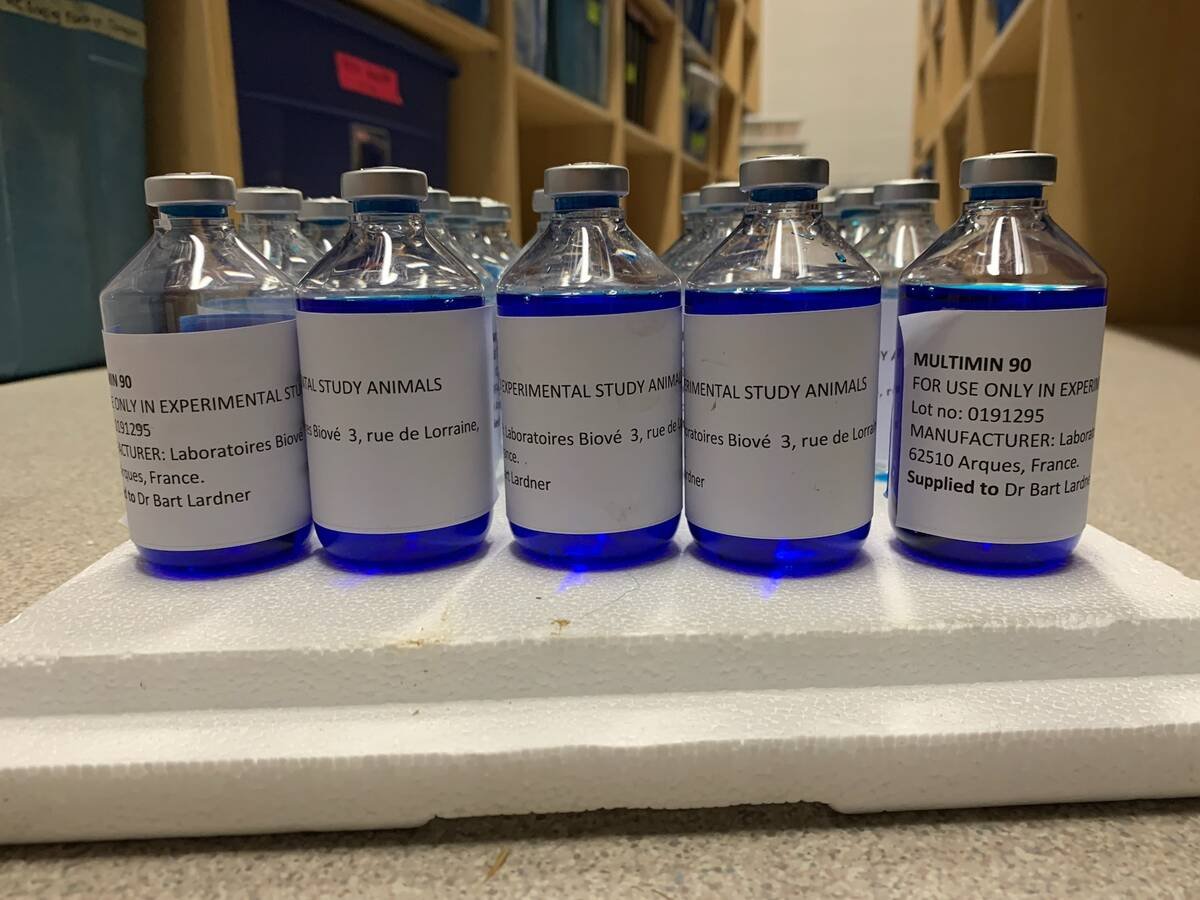
Multimin 90plement a mineral program rather than replace it, its rep says.
Photo:
supplied
Trace mineral deficiencies can undermine cattle performance, fertility and immunity, costing producers more than they may realize.
While some trace mineral deficiencies can result in clinical disease, they may not be clinically obvious and may just result in lowered productivity. However, all can have a negative effect on cattle operations.
Deficiencies that never show up as disease still show up as lost fertility, performance and immunity, and the fix depends on how mineral is fed. Feed and water tests come first, because sodium levels and antagonists such as sulphur and molybdenum decide whether free-choice mineral works.
At the Saskatchewan Stock Growers Association annual general meeting and conference, which took place in June in Swift Current, Sask., Jack Fisher with Multimin 90 spoke about the importance of trace minerals, and the different ways producers can have a mineral program on their operation.
“A fair number of cows, when you start actually measuring (minerals) … and finding out versus just looking at cows, I actually found those cows were short,” Fisher says.
Mineral deficiencies
While speaking about trace mineral deficiencies at the conference, Fisher referenced research done at the University of Saskatchewan, where they surveyed 2,000 cows across the province and found that 43 per cent of them were deficient in copper, and many were short on selenium, but not to the point of being deficient.
Read Also

Evidence-based decisions strengthens cattle operations
Of those cattle that were deficient, about 50 per cent of them were on a free-choice diet.
“Cows on free-choice mineral programs tend to be one-and-a-half times more likely to be copper deficient at calving time,” Fisher says.
There are many factors that can cause mineral deficiencies in cattle, and how the minerals are fed is a big one.
With free-choice minerals, palatability can affect how much the cattle consume — and how much they don’t. It’s also important to make sure the mineral is easily accessible.
“From my experience, cows are inherently lazy. If you ask them to walk very far to go get a supplement, they probably won’t do it. So you need to put it right in their way, so that when they’re going to get water or they’re going somewhere to get something, they pass by the mineral,” Fisher says.
Salt drives intake
Salt is one of the only minerals cattle have a craving for and will seek out. As a result, salt can affect how many other minerals cattle consume.
Salt can be used to attract cattle to free-choice minerals, but when feed is high in salt or water is saline, that will affect how much mineral the cattle consume.
“From my experience, cows are inherently lazy. If you ask them to walk very far to go get a supplement, they probably won’t do it.”
“The more sodium you have in your forages, the more sodium you have in your feed, the less those cows are going to look for salt, the less they’re going to eat the free-choice mineral where salt is your attractant,” Fisher says.
“On dry years where you get alkaline soils drying down, you’ll see sodium contents of those feed being very high, and then you know that probably a typical salt in mineral is not going to be the solution for you.”
Because of this, he emphasizes how important it is to test your feed and water to know what you are working with.
“Make a sodium and mineral profile out of the feeds at the area of the water around you, and then you can start to plan a proper supplementation program.”
Antagonized minerals
While the rumen is beneficial in many ways, it can also create challenges for mineral absorption.
Mineral antagonism occurs when certain minerals in the diet such as sulphur, iron and molybdenum, bind with essential trace minerals in the rumen.
This prevents those important minerals from being absorbed.
Fisher says this is why many people caution against sulphur and molybdenum in feed, because it tends to cause antagonism with other necessary minerals.
To avoid antagonized minerals, Fisher recommends organic or chelated minerals, which are minerals bound to a protein. The protein acts as a carrier, helping the mineral pass through the rumen without being bound by other compounds.
“These two forms in the rumen do not dissolve, do not get bound up by other things,” Fisher says.
Consistent intake is necessary for chelated minerals to be effective.
Even when cattle are fed a mix of chelated and inorganic minerals to make up a deficiency, it can take up to six weeks for their levels to return to normal.
Injectable minerals
Injectable minerals can bypass some of the issues with a free-choice mineral program, such as antagonism or deficiencies, depending on whether the cattle are consuming mineral or not.
Injectable minerals, like Multimin 90, are not a replacement for a whole trace mineral program. But they are a tool to help cattle experiencing deficiencies.
“Multimin 90 is not meant to replace a mineral program. It’s meant to complement it. It’s meant to close that gap pretty quickly and then maintain it with a normal mineral program.”
In times of concern, injectable minerals can increase levels in as short as 24 hours and replenish them in 14 days.
There are other benefits to products like Multimin 90 as well. It can improve vaccine effectiveness and immune responses.
Injectable trace minerals can also be beneficial for artificial insemination, where pregnancy rates are improved by nine to 10 per cent.
“Kansas State University showed that 12 per cent more cows calved in that first cycle, and … those animals are going to be heavier, more uniform, and if you’re retaining heifers out of that first cycle, we heard (about) the benefits of that as well.”
Dosing and timing
MULTIMIN 90 RECOMMENDED DOSAGES
- Cattle up to one year: one mL per 100 lb. bodyweight
- Cattle one to two years: one mL per 150 lb. bodyweight
- Cattle over two years: one mL per 200 lb. bodyweight
Fisher recommends giving cows a dose pre-calving and around breeding because those are times you can assume they will be deficient, or need an extra boost. Calves can be given it around birth, first vaccination and weaning. Bulls can be given it before breeding.
He recommends giving the dose when you are already running the animals through the chute.
“The bottom line: whatever it is you do, it isn’t a feed. … You have to handle the animal, so you want to time it when you’re handling it,” Fisher says.
“I tell some of my own clients that if the problems are bad enough, or you need to do this, you may have to handle your cows an additional time a year to avoid some of the pitfalls.”
Working with your vet
There are a few things to know before using a product like Multimin 90, however. There is a risk of toxicity since it bypasses the rumen and directly enters the bloodstream.
Fisher recommends working with your vet before using Multimin 90.
“You need to use it as part of a program, and it should be co-ordinated with your veterinarian on how to use it appropriately, when to use it, whether you need to do testing in the front end.”
Get insights from our experts delivered to your inbox.
