

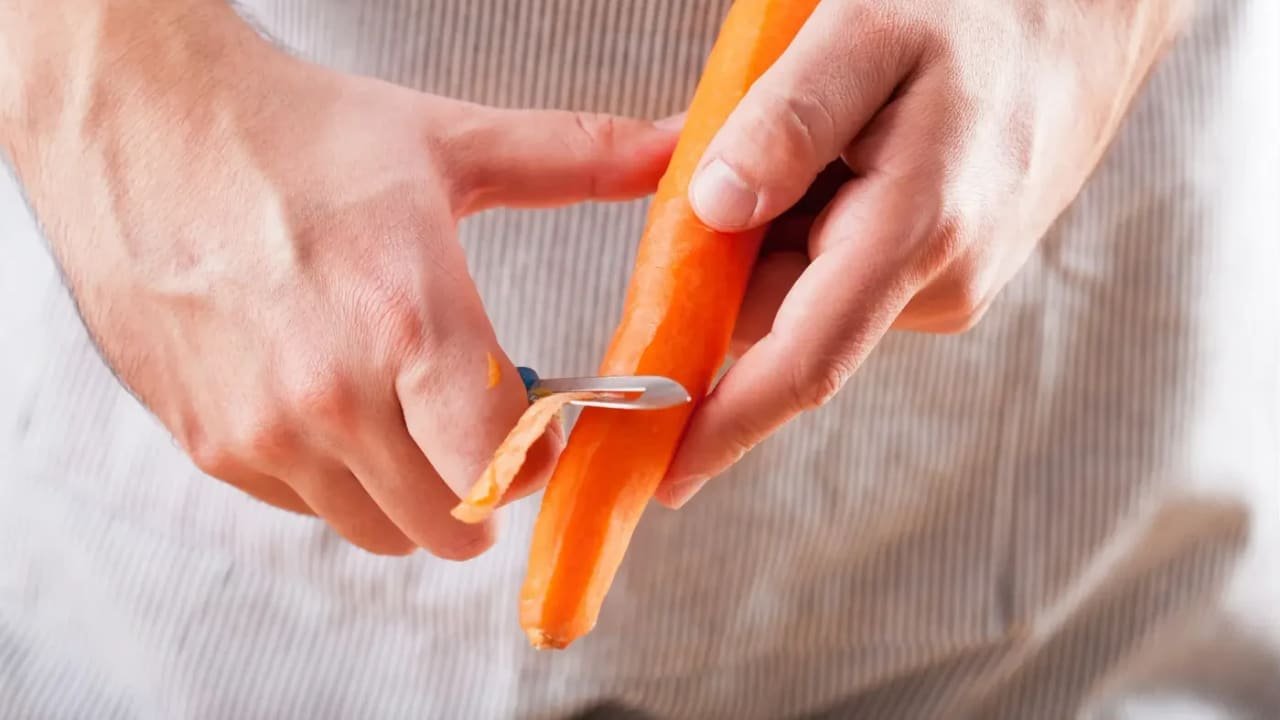
There is a feeling that the peel of vegetables and fruits has become a health symbol. “Don’t peel, all the vitamins are there,” “The peel is most important,” “Most of the nutritional value goes to the trash” – these are sentences that repeat themselves over and over. When is this true and when might it actually be preferable to peel?
So as usual, there is no single correct answer, and certainly not when dealing with such a wide variety of vegetables and fruits.
The considerations we will address will be: The health value, but also the texture of the peel, various sensitivities, digestive problems that certain peels can cause, and perhaps also the pesticide issue that exists in some cases.
It is true that in many fruits and vegetables there is a higher concentration of phytochemicals and antioxidants close to the peel, but this does not mean that the bulk of the nutritional value is in the peel alone. My main message is that in most cases, the vitamins, minerals, and fibers are present throughout the inside of the vegetable or fruit. Peeling really does not “empty” it of nutritional values.
The peel of vegetables and fruits has important roles: For example, the peel protects the plant from pests or radiation. The protection of the plant is through materials that we know as “antioxidants”, meaning they are important for our health.
To protect the plant, these antioxidants are more concentrated in its outer layers, those that can come into contact with pests or radiation.
Does this mean not to peel them? I will address each vegetable or fruit separately.
Potato
When keeping potatoes in light conditions, meaning out of the ground, it protects itself by creating substances that are toxic to insects and pests. They are called solanine and chaconine.
One can easily know about their existence according to the change of the peel color to green, and also the appearance of small bumps of sprouts. They are not just harmful, they are truly toxic.
The recommendation: In case the potato is green or sprouting (such bumps) not only is it advisable to peel, but the peeling must be very thick (a thickness of at least half a cm).
Pay attention – do not skip peeling in this case, if you think that cooking in water or heating will reduce the level of the substance – you are wrong.
Cooking in water (boiling) does not really reduce the concentration of the toxin (a decrease of only about 1.2%), solanine is not soluble in water and does not break down at boiling temperature. (Frying at high temperatures can lead to a decrease of up to 40% in concentration but that is not enough. Not to mention that fried foods are unhealthy in any case).
Sweet potato
The sweet potato peel is rich in insoluble fibers that contribute to satiety, also in minerals like potassium and magnesium concentrated close to the outer layer.
In large sweet potatoes the peel becomes fibrous, hard, and less pleasant to chew after cooking.
The recommendation: If the sweet potato is small and you washed it well, it is recommended to leave the peel. If it is large or fibrous, you can peel it with a quiet mind, plenty of vitamins will remain in it even without.
Zucchini
In the zucchini peel there is a green pigment (chlorophyll) and antioxidants like lutein, which is essential for eye health.
The concentration in the peel is much higher than inside the vegetable. Peeling the zucchini causes a loss of even 60% of the lutein, especially in dark varieties.
Not only that – the peel contains higher concentrations of potassium, magnesium, and phosphorus.
The recommendation: It is better to leave the peel.
Regular zucchinis
Most vitamins are found throughout the zucchini equally. Peeling does not “empty” the zucchini of its value.
The recommendation: The zucchini officially belongs to the “doesn’t really matter” category. One can choose to peel or leave the peel according to personal preference of taste and texture only.
Eggplant
In the purple peel of the eggplant contains anthocyanins, and especially nasunin which is a powerful antioxidant that protects the body’s cells, especially our brain.
In some people, the fibrous peel may burden the digestive system, especially if the eggplant is not baked or cooked well, because then the fibers remain hard and challenging to digest.
The recommendation: You can peel, or simply remember that prolonged cooking, baking, or roasting softens these fibers and improves the availability of antioxidants, without making it difficult for the digestive system.
Carrot
In a carrot there is a very thin peel, and there is no difference in nutritional value between a peeled carrot and an unpeeled carrot.
The beta-carotene, which is the most important vitamin in a carrot, is found in a uniform concentration in all parts of the root.
The recommendation: If the carrot is fresh and washed well, there is no problem at all to eat it with the peel.
Cucumber
In the cucumber peel are found most of the dietary fibers of the vegetable, and also part of the antioxidants and vitamins. But, the peel of the cucumber does not always look good, is not always tasty to us, and is sometimes also bitter.
The recommendation: If the peel is beautiful and whole, and if it is tasty to you – it is worth leaving it. If it is bitter or causes discomfort, peel it with a quiet mind and continue to enjoy the vegetable.
Beet
The beet is rich in betalains – powerful red pigments, which are found inside the entire beet, but, mainly in the area of the peel. Peeling the beet before cooking causes a transition of important substances into the water of the cooking. It is recommended to cook the beet with the peel, and if at all then only after the cooking to peel.
The recommendation: It is better not to peel.
Watermelon
Well surely you did not expect me to talk about watermelon peel. But it turns out that the white part that is between the green peel and the red part– contains fibers and citrulline – an amino acid that contributes to the expansion of blood vessels and to improving blood flow.
Using this part in smoothies or in pickling allows to derive health benefit mainly for the blood vessel system and for recovery after effort.
Contrary to the white part, the outer green part of the watermelon is very hard to digest and is not intended for eating.
The recommendation: Do not throw away. Integrate the white part in smoothies or in pickling.
Mango
It is possible to eat mango peel, in different cuisines in the world they make delicacies from the mango peel (mainly in green mango). But, it is worth warning: The mango peel contains a substance called urushiol, this is a type of resin that is also found in poison ivy.
The recommendation: Whoever has a history of rashes from contact with poison ivy/contact allergies, or whoever experiences tingling/burning around the mouth from mango – it is better to avoid peel.
How can you know if you are sensitive? The reaction appears 24 to 72 hours after touching/eating mango peel, and it causes redness, or itching around the mouth or on the hands. These substances are found only in the peel and not inside the fruit so there is no problem to eat peeled mango (that someone else peeled for you…).
Pomegranate
Considered one of the richestre studies that showed that extracts from pomegranate peel have anti-inflammatory, and anti-cancer effects.
Despite the amazing nutritional benefits, the peel of the pomegranate is very bitter and hard to digest.
The recommendation: Do not eat the peel under any circumstances!
It is used to produce extracts or powders, and not through direct eating
Persimmon
Mainly in the peel, but also a little inside the persimmon itself – there are substances called tannins, especially if the persimmon is not completely ripe.
Tannins in a high quantity can cause a feeling of dryness in the mouth and burden the digestive system, especially in high consumption of unripe fruit.
Consumption of persimmon peel increases the risk of intestinal problems very significantly, and in some people impairs bowel clearance (can cause an obstruction).
The recommendation: In a ripe fruit and in consumption of one persimmon per day there is no prevention to eat the peel,
but actually, it is really really preferable to peel the fruit – especially if there are delicate or sensitive intestines.
Apple
In the peel of apples there are high concentrations of quercetin and polyphenols, but… It is important to remember that also a peeled apple contains important components like soluble fibers (pectin), vitamin C, and phytochemicals.
Many apples today come to us when they are coated with a thin layer of wax (natural or synthetic), which is indeed approved for eating, and is intended to maintain the freshness and the shiny look… But is it harmful? Health-wise no, only it has an effect on the taste and texture.
The recommendation: For whoever struggles with chewing, suffers from sensitivity in the digestive system or simply is deterred by the unpleasant texture of the wax – it is definitely preferable to eat a peeled apple than to give up on the fruit entirely.
Grapes
In the peel of grapes (mainly the dark ones) is found the highest concentration of resveratrol – a powerful antioxidant that was researched extensively in the context of heart health and delaying aging processes.
The recommendation: Always eat with the peel.
The peeling in this case is not only cumbersome, but causes a loss of most of the added value of the fruit. For whoever suffers from bloating or gas, it is recommended to simply reduce the quantity and not to peel.
In some of the cases there is an advantage to eating the peel, mainly in terms of concentration of antioxidants and fibers, but.. Not always. It depends on your sensitivities, on the personal reaction and also probably on taste preferences. On the other hand it is forbidden to forget the huge nutritional value that is inside the fruit or vegetable, regardless of the peel. If the peel is hard, fibrous, unpleasant or makes eating difficult – it is better to peel and not to give up.
In the end, health does not depend on the question of whether you peeled – but whether you ate.
